Forschung
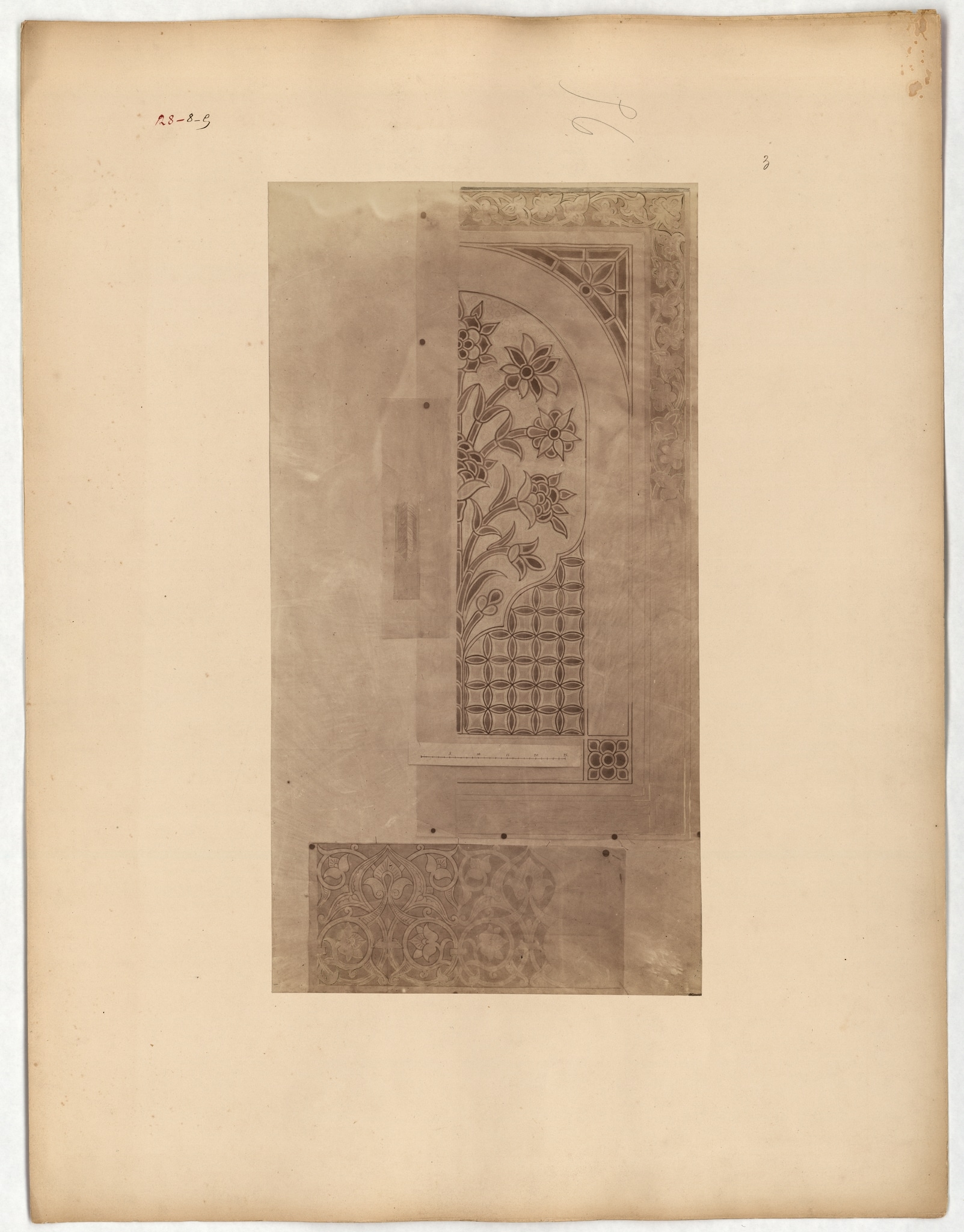
In the archives of Émile Prisse d’Avennes (1807–1879) two mounted and retouched photographs (fol. 3 and 5, IG_467, IG_488) are preserved in the album Art Arabe. Dessins: Arabesques, 5. They are preparatory works for the French archaeologist’s book L’Art arabe d’après les monuments du Kaire depuis le VIIe siècle jusqu’à la fin du XVIIIe, published in 1877.
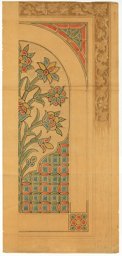
The windows on fol. 5 were reconstructed from fragments. Prisse d’Avennes explains that he had been able to buy in Paris three boxes with fragments of six stucco and glass windows from a mosque in Egypt. In 1867, these windows had been sent from Egypt to the world’s fair in Paris, but had not survived the journey and therefore arrived there in pieces. Prisse d’Avennes succeeded in reconstructing two windows (Prisse d’Avennes, 1869–1877, vol. 1, pp. 154, 278, vol. 3, pl. CXLV; Keller, 2020, p. 31). A photograph of these fragments can be found in one of Prisse d’Avennes’ Cairo’s portfolios (IG_86). As the photograph discussed here (fol. 3) is very similar in appearance to fol. 5 (IG_188), it probably also shows a window reconstructed from the same batch of fragments. A drawing (IG_489) also preserved in the album shows the same window in colours. Prisse d’Avennes gives no information about its provenance. The composition, with a lattice ornament in the lower section, is unusual. A scale gives the dimensions of the window: with the frame, the width of the half window would have been 41 cm and the height c.113 cm.
No plate in the book shows a similar window. However, the frieze with interlacing tendrils depicted on a separate board below the window, is reproduced in plate CXLIV **(IG_42), below another stucco and glass window.
Prisse d'Avennes repeatedly used photographs to create his lithographs. For the expedition to Egypt in 1858–1860, he had recruited Willem de Famars Testas (1834–1896) as draughtsman and Édouard Jarrot (1835–1873) as photographer. Some of the photographs made on the journey had later been retouched, mostly to emphasise the contours, which simplified the work of the lithographer. This work was one of the tasks of de Famars Testas (de Hond, 2013, p. 85–86). The two retouched photographs of stucco and glass windows, however, were not made in Egypt but in Paris.
Datierung
c. 1870
Zeitraum
1860 – 1877
Herstellungsort