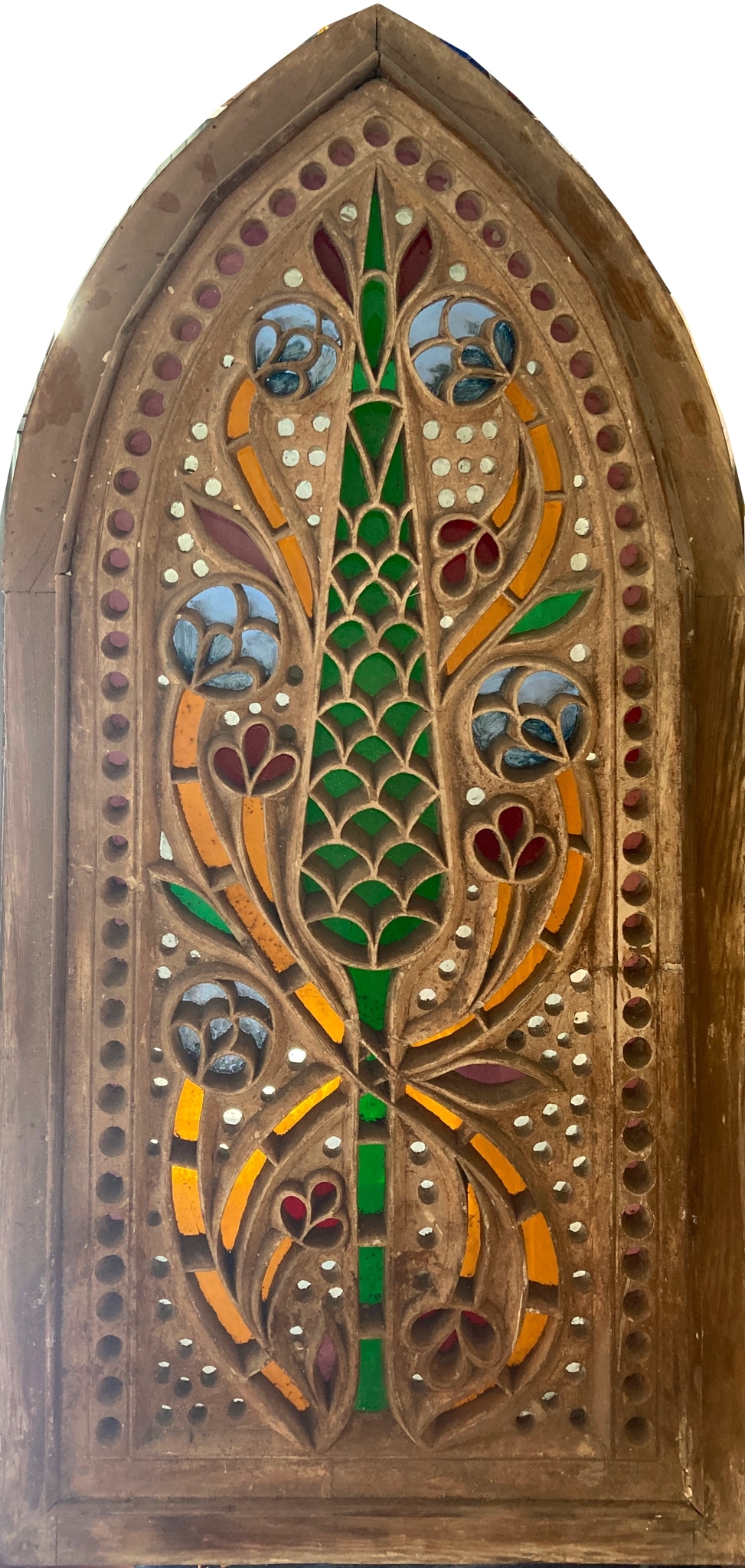
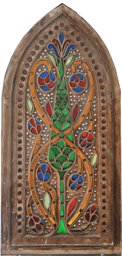
From a technical and iconographic point of view, this stucco and glass window corresponds to one of the standard types of qamariyya widespread in Egypt during the Ottoman period. Similar windows can be found in several of the collections studied (see for instance IG_18, IG_173, IG_355). The representation of a cypress tree surrounded by a flower tendril is a widespread motif in Islamic arts. It can be found in numerous other media, such as ceramics, wood panelling, wall paintings, and textiles, over a long period of time, and in both sacred and profane contexts.
Stucco and glass windows of this type are illustrated in 19th- and early 20th-century publications (see for instance IG_42, IG_47). The cypress-tree motif also aroused the interest of Western artists and architects, as is attested by the significant number of sketches and paintings of the motif (IG_118, IG_136, IG_150, IG_153, IG_438, IG_439, IG_468), as well by the replicas of such windows installed in Arab-style interiors across Europe (IG_56, IG_64, IG_427–IG_430).
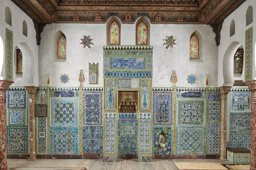
The French naval officer and novelist Pierre Loti (1850–1923), who had this stucco and glass window installed in the qibla-like eastern wall of the so-called mosque built between 1895 and 1897 in his family’s house at Rochefort (France), was familiar with such windows from his extensive travels. In 1894, he embarked on a journey through Egypt, Palestine, and Turkey and subsequently published his observations and experiences in the trilogy Le désert (1894), Jérusalem (1895), and La Galilée (1896), as well as in the novel La mosquée verte (1896). In Jérusalem (Loti, 1895, p. 72), Loti relates his visit to the Dome of the Rock and pays particular attention to the stucco and glass windows and their luminous effects. He compares them to precious stones, praises the effect of the stucco grille, and describes the angling of the perforations. According to his accounts, Loti visited also traditional residences. He was even received in two reception halls (qāʾa) in Damascus, which are described in La Galilée and later inspired him in relation to his ‘mosque’ at Rochefort (Loti, 1896, pp. 144, 146). In La mosquée verte, he comments on these windows again, this time those in the tomb of Mehmed I in Bursa. After mentioning other furnishings there, such as the ceramic tiles and the carpets, the stucco and glass windows are described as follows: “Des petits vitraux, haut perchés, tout près du dôme, et travaillés autant que des pièces de bijouterie, laissant descendre une lumière changeante, comme filtrée au travers de pierres précieuses.” (Loti, 1896, p. 233).
Owing to the formal, compositional, and technical characteristics of the window, Thierry Liot’s assumption that it may also have belonged to the late 18th-century Damascene house from which the ceiling, mihrab, and woodwork of Loti’s ‘mosque’ at Rochefort are thought to have originated (Liot, 1999, p. 130; see also Giraud-Heraud, 1996, pp. 64–65) has to be rejected. In fact, it is much more likely that this window, together with IG_427, IG_428, and IG_430, is a replica made in France on the basis of IG_426. The pointed-arch form of the stucco panel and the unusual outline of the flower tendrils point to a Western designer, perhaps Loti himself, and the extremely flat surface of the stucco grill is very different from windows manufactured in Egypt, including IG_426. While the stucco latticework of traditional Islamic windows such as IG 426 is carved, it seems that the grille of this window was cast; moreover, the pieces of glass used in this window differ from those of IG_426 on account of their regular shape (especially in the border area) and large size (they back several openings of the stucco lattice at once). These observations support the assumption that the replica was made in France and not in Egypt. Very atypical for Islamic stucco and glass windows also are the round pieces of glass backing entire rose blossoms, which in all the other windows examined within the project are backed by several smaller pieces. It is unclear whether the round pieces of glass here are original, or whether they are replacements made in the course of an undocumented restoration.
All four replicas were installed in the qibla-like eastern wall of Loti’s ‘mosque’. Like Loti’s other windows, this specimen was protected from the weather on the outward-facing rear side by means of a 4mm-thick pane of glass at an unknown date, but most probably in connection with the window’s installation at Rochefort.