Image commandée

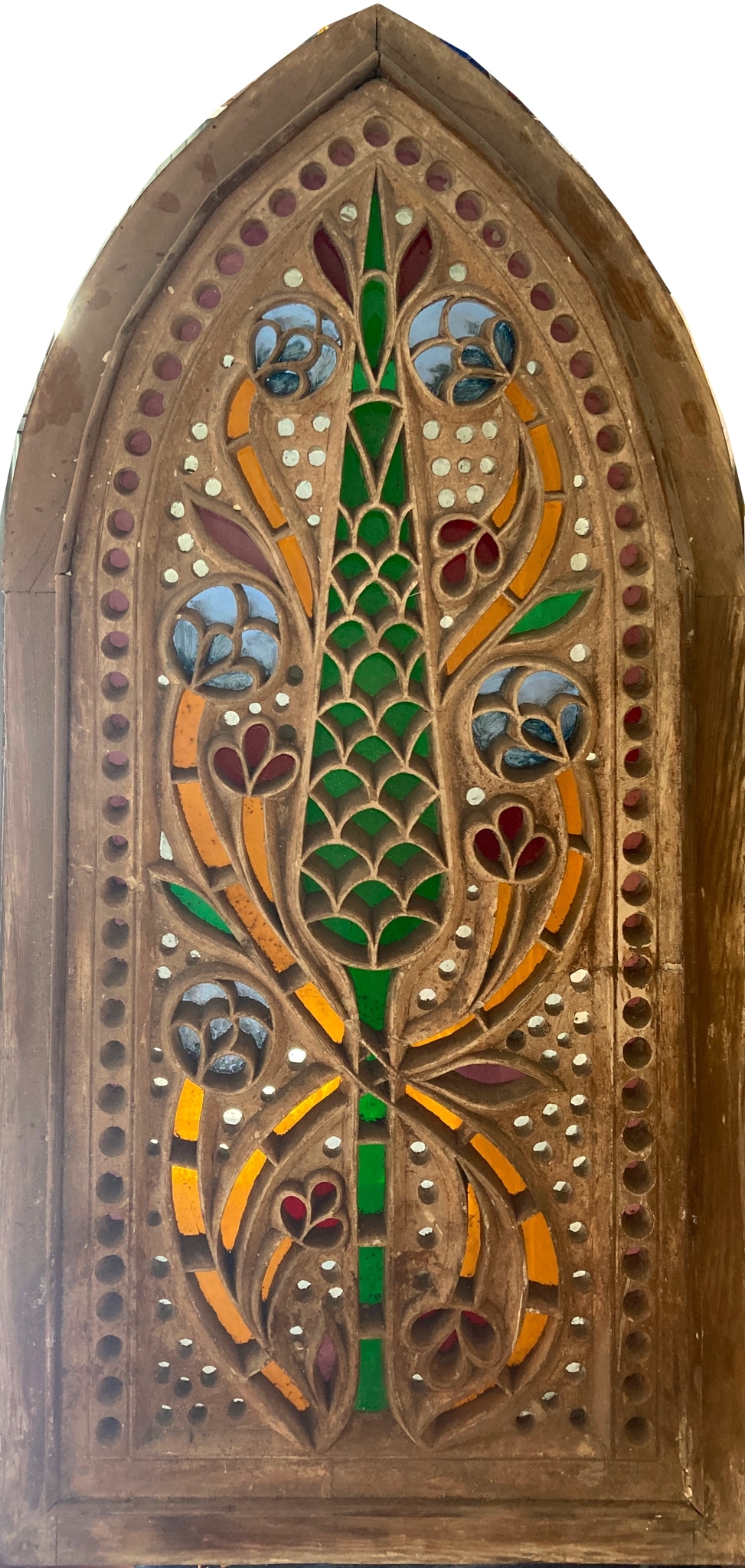
IG_429: Replica of stucco glass window with cypress tree and flower tendril
(FRA_Rochefort_MaisonPierreLoti_IG_429)

Coordonnées

Prière de compléter le champ "Prénom".
Prière de compléter le champ "Nom".
Prière de compléter le champ "E-Mail".
Votre adresse e-mail n'est pas valide.

Veuillez s’il vous plaît indiquer autant d’informations que possible (titre de la publication, base de données, éditeur, nombre d’exemplaires, année de parution, etc.)

Le Vitrocentre Romont ne peut mettre à votre disposition que ses propres images. Nous ne pouvons malheureusement pas vous fournir des images de tiers. Si votre commande concerne des photographies de tiers, nous vous enverrons volontiers l'adresse de contact où vous pourrez obtenir les images.

Les données personnelles que vous avez indiquées dans ce formulaire sont utilisées par le Vitrocentre Romont exclusivement pour le traitement de votre commande d'images. La correspondance relative à la commande est archivée à des fins de traçabilité interne. Les données ne seront utilisées à aucune autre fin que celles énumérées ici, ni transmises à des tiers. En envoyant un formulaire de commande, vous acceptez tacitement cette utilisation de vos données personnelles.

Pour toute question complémentaire, veuillez contacter info@vitrosearch.ch.

Titre

Replica of a stucco and glass window with cypress tree and flower tendril

Type d'objet
Dimensions
97 x 47 x 4 cm (with frame); 88.5 x 38.5 x 4 cm (without frame)
Artiste
Lieu de production
France · ?
Datation
1895–1897
Lieu
Emplacement
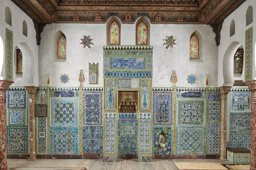
Mosque, eastern wall, E IV
Projet de recherche
Auteur·e et date de la notice
Francine Giese, Sarah Keller 2025

Iconographie

Description

Pointed-arch stucco and glass window with a green cypress tree in the centre. The scale-like pattern usually used to represent the foliage of the cypress is replaced in the upper part by geometric ornament, and the top of the tree is flanked by two leaves. Two flower tendrils with stylized roses and three-petalled flowers spring from the foot of the tree and cross at the upper part of the cypress’s trunk. Two more rose tendrils spring from the side of the foliage, at mid-height. The cypress tree and tendrils are framed by a pointed arch and surrounded by a perforated background, which is slightly recessed.

The panel is held in a wooden frame. The front of the grille is painted with red-brown paint. The backside of the window is protected with a 4mm-thick glass pane.

Code Iconclass
25G3(CYPRESS) · arbres : cyprès
25G41(ROSE) · fleurs : rose
48A98783 · entrelacs de fleurs ~ ornement
Mot-clés Iconclass
cyprès · fleur · rose

Matériaux, technique et état de conservation

Matériaux

Fine-grained gypsum plaster; colourless glass with a greyish or bluish tint; coloured glass (green, blue, orange, purple, red flashed glass); wood; brown paint.

Technique

The stucco grille was produced using the casting technique. The coloured glass pieces were fixed on the back of the lattice with a thin layer of gypsum plaster with a thickness of c.2mm. The average thickness of the stucco panel is 25mm. The panel is held in a profiled wooden frame, which measures 40 x 40 x 40mm.


The design of the latticework has two levels: The main motif is level 0, which stands out about 10mm against a perforated background (level -1). The perforations are regularly spaced and have diameters varying between 10–14mm. The distance between the holes is 5–10mm. All holes are backed with colourless glass. The main design and the perforations have been worked in such a way that the incident light is directed downwards into the room. At an unspecified date, the front of the latticework was painted brown. Black paint was applied on the front side of some of the blue glass pieces, possibly to reduce their brightness.

The glass is either colourless or coloured in the mass. Elongated, parallel bubbles suggest that the glass is cylinder-blown. The glass pieces are very large compared to those of other stucco and glass windows and cover several openings of the grille. Scratch marks along the edges of some glass pieces show that the glass was cut using a glass cutter.

Etat de conservation et restaurations

The latticework is dusty but largely intact. The are only few small losses on the frontside of the stucco panel. The glass pane, attached to protect the back of the window, is also intact. There are possible traces of mold in the interspace between the protective glass and the back of the panel.

Historique de l'oeuvre

Recherche

From a technical and iconographic point of view, this stucco and glass window corresponds to one of the standard types of qamariyya widespread in Egypt during the Ottoman period. Similar windows can be found in several of the collections studied (see for instance IG_18, IG_173, IG_355). The representation of a cypress tree surrounded by a flower tendril is a widespread motif in Islamic arts. It can be found in numerous other media, such as ceramics, wood panelling, wall paintings, and textiles, over a long period of time, and in both sacred and profane contexts.

Stucco and glass windows of this type are illustrated in 19th- and early 20th-century publications (see for instance IG_42, IG_47). The cypress-tree motif also aroused the interest of Western artists and architects, as is attested by the significant number of sketches and paintings of the motif (IG_118, IG_136, IG_150, IG_153, IG_438, IG_439, IG_468), as well by the replicas of such windows installed in Arab-style interiors across Europe (IG_56, IG_64, IG_427IG_430).

The French naval officer and novelist Pierre Loti (1850–1923), who had this stucco and glass window installed in the qibla-like eastern wall of the so-called mosque built between 1895 and 1897 in his family’s house at Rochefort (France), was familiar with such windows from his extensive travels. In 1894, he embarked on a journey through Egypt, Palestine, and Turkey and subsequently published his observations and experiences in the trilogy Le désert (1894), Jérusalem (1895), and La Galilée (1896), as well as in the novel La mosquée verte (1896). In Jérusalem (Loti, 1895, p. 72), Loti relates his visit to the Dome of the Rock and pays particular attention to the stucco and glass windows and their luminous effects. He compares them to precious stones, praises the effect of the stucco grille, and describes the angling of the perforations. According to his accounts, Loti visited also traditional residences. He was even received in two reception halls (qāʾa) in Damascus, which are described in La Galilée and later inspired him in relation to his ‘mosque’ at Rochefort (Loti, 1896, pp. 144, 146). In La mosquée verte, he comments on these windows again, this time those in the tomb of Mehmed I in Bursa. After mentioning other furnishings there, such as the ceramic tiles and the carpets, the stucco and glass windows are described as follows: “Des petits vitraux, haut perchés, tout près du dôme, et travaillés autant que des pièces de bijouterie, laissant descendre une lumière changeante, comme filtrée au travers de pierres précieuses.” (Loti, 1896, p. 233).

Owing to the formal, compositional, and technical characteristics of the window, Thierry Liot’s assumption that it may also have belonged to the late 18th-century Damascene house from which the ceiling, mihrab, and woodwork of Loti’s ‘mosque’ at Rochefort are thought to have originated (Liot, 1999, p. 130; see also Giraud-Heraud, 1996, pp. 64–65) has to be rejected. In fact, it is much more likely that this window, together with IG_427, IG_428, and IG_430, is a replica made in France on the basis of IG_426. The pointed-arch form of the stucco panel and the unusual outline of the flower tendrils point to a Western designer, perhaps Loti himself, and the extremely flat surface of the stucco grill is very different from windows manufactured in Egypt, including IG_426. While the stucco latticework of traditional Islamic windows such as IG 426 is carved, it seems that the grille of this window was cast; moreover, the pieces of glass used in this window differ from those of IG_426 on account of their regular shape (especially in the border area) and large size (they back several openings of the stucco lattice at once). These observations support the assumption that the replica was made in France and not in Egypt. Very atypical for Islamic stucco and glass windows also are the round pieces of glass backing entire rose blossoms, which in all the other windows examined within the project are backed by several smaller pieces. It is unclear whether the round pieces of glass here are original, or whether they are replacements made in the course of an undocumented restoration.

All four replicas were installed in the qibla-like eastern wall of Loti’s ‘mosque’. Like Loti’s other windows, this specimen was protected from the weather on the outward-facing rear side by means of a 4mm-thick pane of glass at an unknown date, but most probably in connection with the window’s installation at Rochefort.

Datation
1895–1897
Période
1895 – 1897
Commanditaire / Donateur·trice
Sites antérieures
Lieu de production
France · ?

Provenance

Propriétaire

Maison de Pierre Loti

Bibliographie et sources

Bibliographie

Giraud-Heraud, C. (1996). Les salles orientales de la maison Pierre Loti à Rochefort. Unpublished thesis (Mémoire de Diplôme d'Etudes Approfondies), Université de Paris-Sorbonne-Paris IV. Paris.

Liot, T. (1999). La maison de Pierre Loti à Rochefort 1850–1923. Chauray: Patrimoines et médias.

Loti, P. (1894). Le désert. Nouvelle Revue 90, September–October, pp. 225–257, 449–472, 673-693; Nouvelle Revue 91, November–December, pp. 6–26, 225–247, 449–463.

Loti, P. (1895). Jérusalem. Paris: C. Lévy.

Loti, P. (1896). La Galilée. Paris: C. Lévy.

Informations sur l'image

Nom de l'image
FRA_Rochefort_MaisonPierreLoti_IG_429
Crédits photographiques
@ Vitrocentre Romont
Date de la photographie
2023

Objets et images liés

Objets liés
Replica of a stucco and glass window with cypress tree and flower tendril
Photographies complémentaires
'mosque' of Maison Pierre Loti, Rochefort

Proposition de citation

Giese, F., & Keller, S. (2025). Replica of a stucco and glass window with cypress tree and flower tendril. Dans Vitrosearch. Consulté le 5 décembre 2025 de https://www.vitrosearch.ch/objects/2713273.

Informations sur l’enregistrement

Numéro de référence
IG_429