Bestelltes Bild

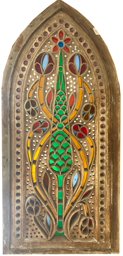
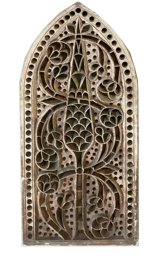
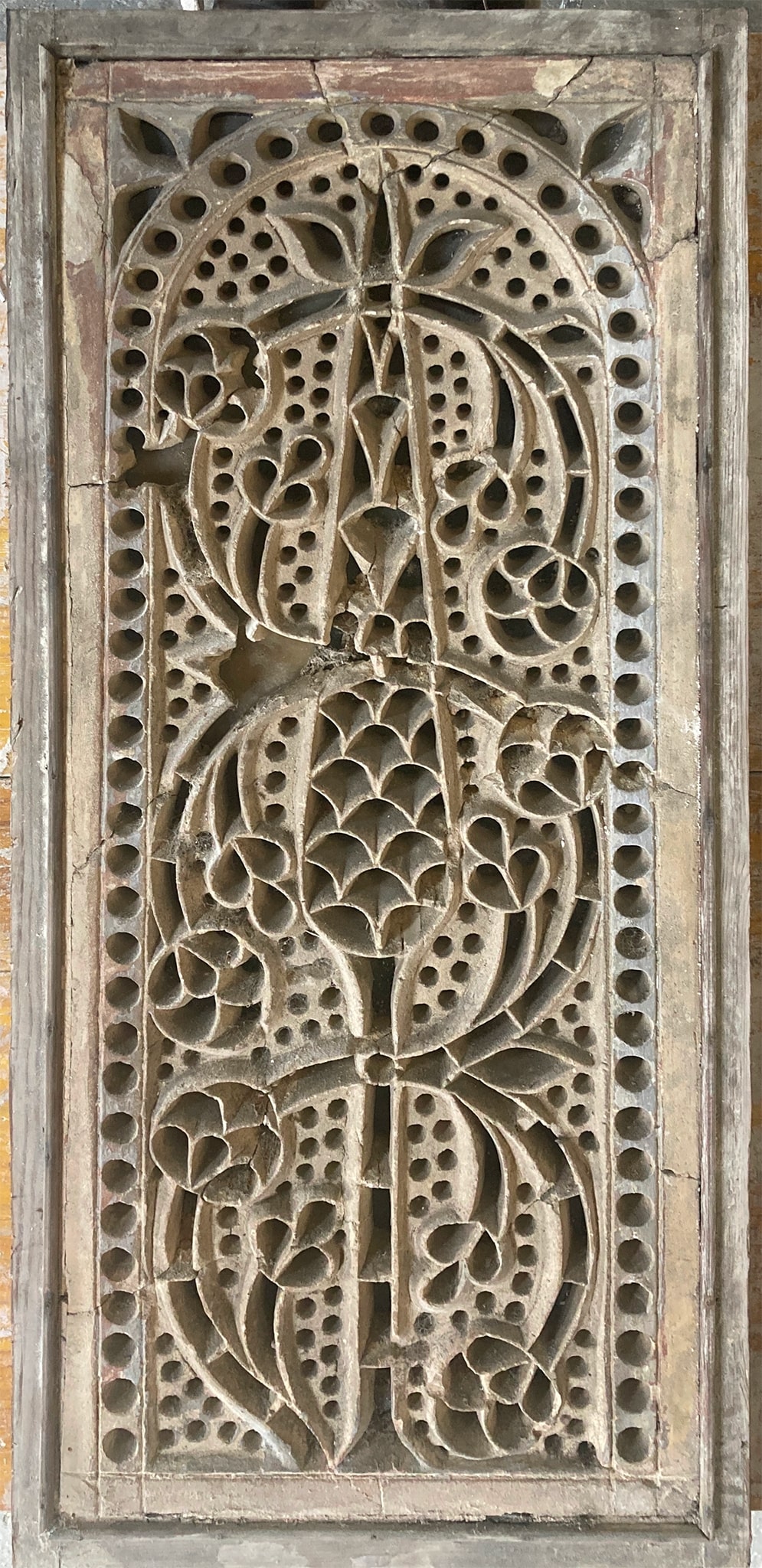
IG_426: Stucco glass window with cypress tree and flower tendril
(FRA_Rochefort_MaisonPierreLoti_IG_426)

Kontaktdaten

Bitte geben Sie Ihren Vornamen ein.
Bitte geben Sie Ihren Namen ein.
Bitte geben Sie Ihre E-Mail-Adresse ein.
Die E-Mail-Adresse ist ungültig.

Bitte machen Sie so viele Angaben wie möglich (Titel der Publikation, Datenbank, Herausgeber, Auflage, Erscheinungsjahr, usw.)

Das Vitrocentre Romont kann Ihnen nur eigene Bilder zur Verfügung stellen. Bilder von Dritten können wir Ihnen leider nicht überlassen. Betrifft Ihre Bestellung Fotografien von Drittparteien, senden wir Ihnen die Kontaktadresse, über welche die Bilder bezogen werden können.

Die von Ihnen in diesem Formular angegebenen Personendaten werden vom Vitrocentre Romont ausschliesslich für die Bearbeitung Ihrer Bildbestellung verwendet. Die Korrespondenz zur Bestellung wird zur internen Nachvollziehbarkeit archiviert. Die Daten werden weder für andere als die hier aufgelisteten Zwecke verwendet noch an Dritte weitergegeben. Durch das Absenden des Bestellformulars erklären Sie sich mit dieser Nutzung Ihrer Personendaten einverstanden.

Bei Fragen können Sie gerne eine E-Mail an info@vitrosearch.ch senden.

Titel

Stucco and glass window with cypress tree and flower tendril

Art des Objekts
Masse
102 x 45 x 4 cm (with frame); 95 x 39 x 4 cm (without frame)
Künstler:in / Hersteller:in
Herstellungsort
Datierung
early 13th–early 14th century AH / 19th century CE
Standort
Lage
Mosque, eastern wall, northern gallery, E I
Forschungsprojekt
Autor:in und Datum des Eintrags
Francine Giese, Sarah Keller 2025

Ikonografie

Beschreibung

Rectangular stucco and glass window with a green cypress tree in the centre, surrounded by an S-shaped winding flower tendril with stylized roses and three-petalled flowers. The scale-like pattern usually used to represent the foliage of the cypress tree is replaced in the upper part by geometric ornament, and the top of the tree is flanked by two leaves. The cypress tree and tendril are framed by a semicircular arch. The spandrels are decorated with three-petalled floral ornament. The cypress tree and the tendril are surrounded by a perforated background, which is slightly recessed.

The stucco panel is held in a wooden frame. The edges of the stucco panel show remnants of light grey and red paint. The backside of the window is protected with a 4mm-thick glass pane.

Iconclass Code
25G3(CYPRESS) · Bäume: Zypresse
25G41(ROSE) · Blumen: Rose
48A98783 · Blumenflechtwerk
Iconclass Stichworte
Blume · Rose · Zypresse

Materialien, Technik und Erhaltungszustand

Materialien

Coarse-grained gypsum plaster; colourless glass; coloured glass (green, blue, orange); wood; red and light grey paint.

Technik

Latticework carved into a rectangular stucco panel and inlaid with pieces of colourless and coloured sheet glass. The latticework is held in a wooden frame.

The openings in the lattice were cut out of the stucco panel, when it was not yet completely set, using sharp tools. Once the latticework was finished, the coloured glass pieces, cut to the size of the openings using a glass cutter, were embedded in a thin layer of gypsum plaster and fixed to the back. This layer is on average 2–3mm thick. The thickness of the stucco panel is c.27–30mm.

The design of the latticework has two levels: the main motif (level 0) has been carved out of the stucco panel with a sharp, knife-like tool following a template incised in the surface of the panel. The second level (level -1), which lies 10mm below level 0, shows regularly spaced, conical perforations. The holes were pierced with a metal or wooden pin in the stucco that had not yet fully set. They have diameters varying between 10–12mm and are slightly tapered towards the back. The distance between the holes is 4–10mm. All holes are backed with colourless glass. The main design and the perforations have been worked in such a way that the incident light is directed downwards into the room. At an unspecified point in time, the front of stucco panel was painted along the edges with red and grey-blue paint.


The glass is either colourless or coloured in the mass. Elongated, parallel bubbles indicate that the glass sheets were mouth-blown, probably using the broadsheet method. The glass pieces were cut according to the design of the latticework using a glass cutter. Some of the pieces have grozed edges. The coloured glass has an average thickness of 2mm.

Erhaltungszustand und Restaurierungen

The stucco panel shows several large losses and cracks. In the damaged areas, the glass pieces are missing. The red and light grey paint that was applied along the edges of the stucco panel is only partially preserved. The glass pane, attached to protect the back of the window, is intact. There are possible traces of mold in the interspace between the protective glass and the back of the panel.

Entstehungsgeschichte

Forschung

From a technical and iconographic point of view, this stucco and glass window corresponds to one of the standard types of qamariyya widespread in Egypt during the Ottoman period. Similar windows can be found in several of the collections studied (see for instance IG_18, IG_173, IG_355). The representation of a cypress tree surrounded by a flower tendril is a widespread motif in Islamic arts. It can be found in numerous other media, such as ceramics, wood panelling, wall paintings, and textiles, over a long period of time, and in both sacred and profane contexts.

Stucco and glass windows of this type are illustrated in 19th- and early 20th-century publications (see for instance IG_42, IG_47). The cypress-tree motif also aroused the interest of Western artists and architects, as is attested by the significant number of sketches and paintings of the motif (IG_118, IG_136, IG_150, IG_153, IG_438, IG_439, IG_468), as well by the replicas of such windows installed in Arab-style interiors across Europe (IG_56, IG_64, IG_427IG_430).

The French naval officer and novelist Pierre Loti (1850–1923), who had this stucco and glass window installed in the northern gallery of the so-called mosque built between 1895 and 1897 in his family’s house in Rochefort (France), was familiar with such windows from his extensive travels. In 1894, he embarked on a journey through Egypt, Palestine, and Turkey and subsequently published his observations and experiences in the trilogy Le désert (1894), Jérusalem (1895), and La Galilée (1896), as well as in the novel La mosquée verte (1896). In Jérusalem (Loti, 1895, p. 72), Loti relates his visit to the Dome of the Rock and pays particular attention to the stucco and glass windows and their luminous effects. He compares them to precious stones, praises the effect of the stucco grille, and describes the angling of the perforations. According to his accounts, Loti also visited traditional residences. He was even received in two reception halls (qāʾa) in Damascus, which are described in La Galilée and later inspired him in relation to his ‘mosque’ at Rochefort (Loti, 1896, p. 144, 146). In La mosquée verte, he comments on these windows again, this time those in the tomb of Mehmed I in Bursa. After mentioning other furnishings, such as the ceramic tiles and the carpets, the stucco and glass windows are described as follows: “Des petits vitraux, haut perchés, tout près du dôme, et travaillés autant que des pièces de bijouterie, laissant descendre une lumière changeante, comme filtrée au travers de pierres précieuses.” (Loti, 1896, p. 233).

According to Thierry Liot, this stucco and glass window may have belonged to the late 18th-century Damascene house from which the ceiling, mihrab, and woodwork of Loti’s ‘mosque’ at Rochefort are thought to have originated (Liot, 1999, p. 130; see also Giraud-Heraud, 1996, pp. 64–65). While it seems very likely that this window was manufactured in an Islamic land, its design, composition, and manufacturing technique point to Egypt rather than to Syria, which is why it is also possible that Loti acquired the window on the art market. Owing to the window’s formal and compositional characteristics, as well as the state of preservation of the stucco grille and the type of glass used, a dating to the 19th century may be more probable.

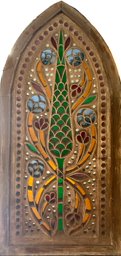
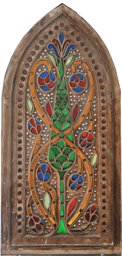
The present window seems to have inspired the four replicas IG_427IG_430, installed next to this one in the qibla-like eastern wall of Loti’s ‘mosque’. Like the replicas, this specimen was protected from the weather on the outward-facing rear side by means of a 4mm-thick pane of glass at an unknown date, but most probably in connection with the window’s installation at Rochefort.

Datierung
early 13th–early 14th century AH / 19th century CE
Zeitraum
1800 – 1899
StifterIn
Frühere Standorte
Herstellungsort

Provenienz

Eigentümer:in

Maison de Pierre Loti

Vorbesitzer:in

Bibliografie und Quellen

Literatur

Giraud-Heraud, C. (1996). Les salles orientales de la maison Pierre Loti à Rochefort. Unpublished thesis (Mémoire de Diplôme d'Etudes Approfondies), Université de Paris-Sorbonne-Paris IV. Paris.

Liot, T. (1999). La maison de Pierre Loti à Rochefort 1850–1923. Chauray: Patrimoines et médias.

Loti, P. (1894). Le désert. Nouvelle Revue 90, September–October, pp. 225–257, 449–472, 673-693; Nouvelle Revue 91, November–December, pp. 6–26, 225–247, 449–463.

Loti, P. (1895). Jérusalem. Paris: C. Lévy.

Loti, P. (1896). La Galilée. Paris: C. Lévy.

Bildinformationen

Name des Bildes
FRA_Rochefort_MaisonPierreLoti_IG_426
Fotonachweise
@ Vitrocentre Romont
Aufnahmedatum
2023

Weiteres Bildmaterial und verwandte Objekte

Verwandte Objekte
Replica of a stucco and glass window with cypress tree and flower tendril
Zusätzliches Bildmaterial
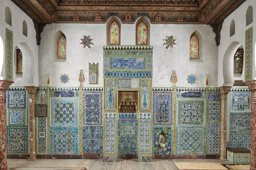
'mosque' of Maison Pierre Loti, Rochefort

Zitiervorschlag

Giese, F., & Keller, S. (2025). Stucco and glass window with cypress tree and flower tendril. In Vitrosearch. Aufgerufen am 5. Dezember 2025 von https://www.vitrosearch.ch/objects/2713270.

Informationen zum Datensatz

Referenznummer
IG_426