Beschreibung
‘d’après une photographie de l’auteur’; ill. no. 175 in Le Bon, La Civilisation des Arabes, 1884.
A round window with a central Arabic inscription.
Iconclass Code
Iconclass Stichworte

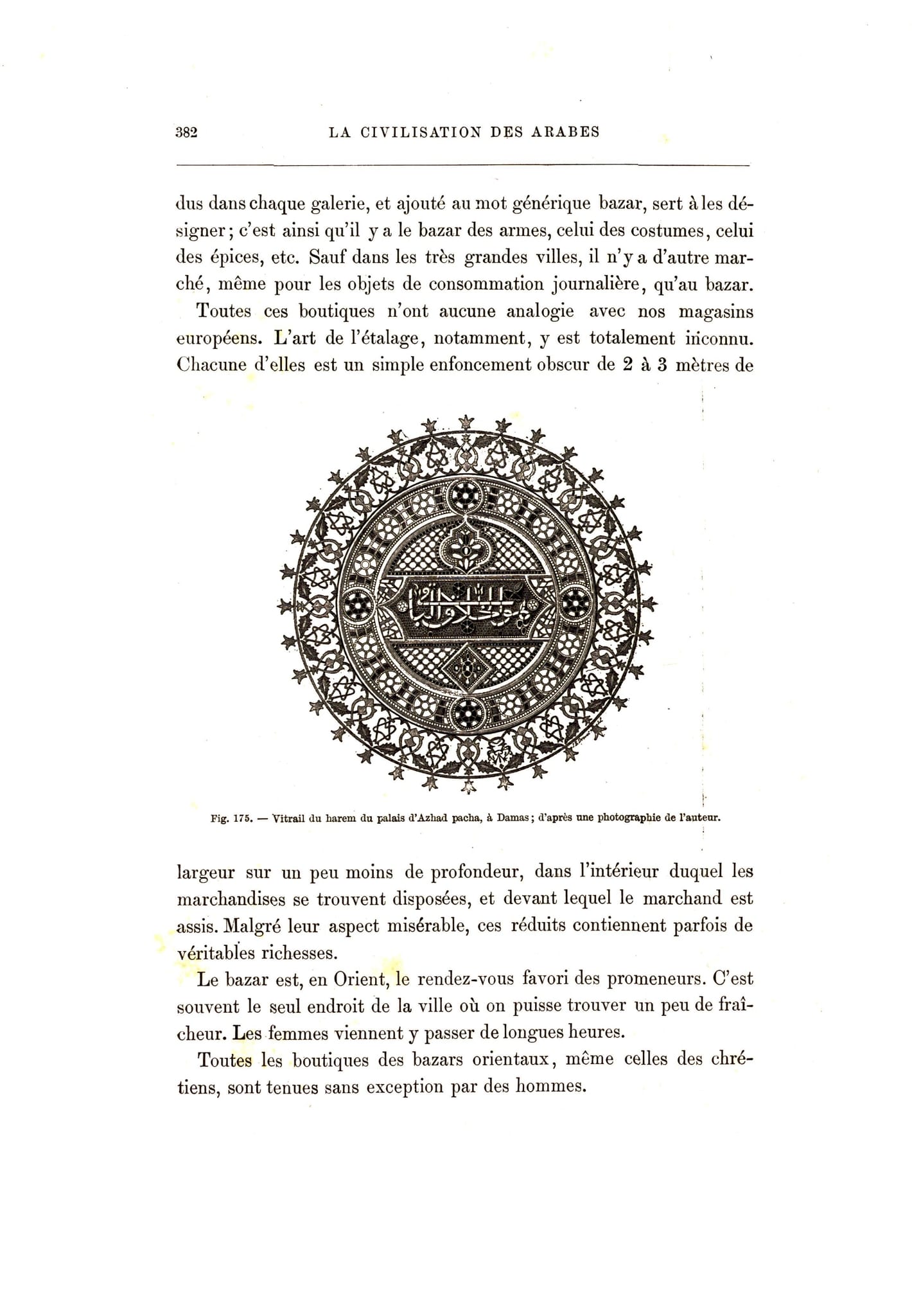
‘d’après une photographie de l’auteur’; ill. no. 175 in Le Bon, La Civilisation des Arabes, 1884.
A round window with a central Arabic inscription.
This window probably dates to 1749/50, when the Qasr al-ʿAzm, a private residence in Damascus, was built. Le Bon’s fig. 201 shows the qāʿa and the northern ṭirz, with the window in the upper part of the wall, and fig. 175 the round window. The author only briefly comments on the palace and states that it is one of the oldest buildings in Damascus, and the most beautiful.
A photograph taken by the Maison Bonfils in 1890, shows the same view as Le Bon’s fig. 201 (Fine Arts Library, Harvard College Library; Archnet, 2023). In 1925, the palace was heavily damaged and the stucco and glass window destroyed.
Circular stucco and glass windows have a long tradition, going back to Ayyubid and Mamluk times (see Flood, 1993, p. 83, figs 40, 44). In Cairene mosques, they were often placed over the mihrab (see IG_188, IG_295). In Damascus, the Yalbugha Mosque (747–8/1347–8) has several circular windows, also in the qibla wall.
No circular windows entered European collections. The Damascus Room in The Metropolitan Museum of Art displays a round window on the same place as in the Qasr al-ʿAzm, but it dates to the 1970s (Kenney, & Baumeister, 2011).
Archnet (2023). Qasr al-'Azm (Damascus). Retrieved from https://www.archnet.org/sites/3074?media_content_id=125052.
Bali, J. (2016). Différentes approches de « restauration » en Syrie : de Michel Ecochard aux projets de l’Aga Khan Trust pour la Culture. Master thesis. Retrieved from https://archive-ouverte.unige.ch/unige:96215.
Flood, F. B. (1993). Palaces of crystal, sanctuaries of light: windows, jewels and glass in medieval islamic architecture [PhD thesis, University of Edinburg]. Edinburgh College of Art thesis and dissertation collection. Retrieved from https://era.ed.ac.uk/handle/1842/19754.
Kenney, E., & Baumeister, M. (2011). Reception Room (Qa’a). In Ekhtiar, Soucek, Canby, & Haidar (eds.). Masterpieces from the Department of Islamic Art in The Metropolitan Museum of Art (no. 238, pp. 7, 13–14, 333–37). New York: The Metropolitan Museum of Art. Retrieved from https://www.metmuseum.org/art/collection/search/452102?ft=damascus&offset=0&rpp=40&pos=1.