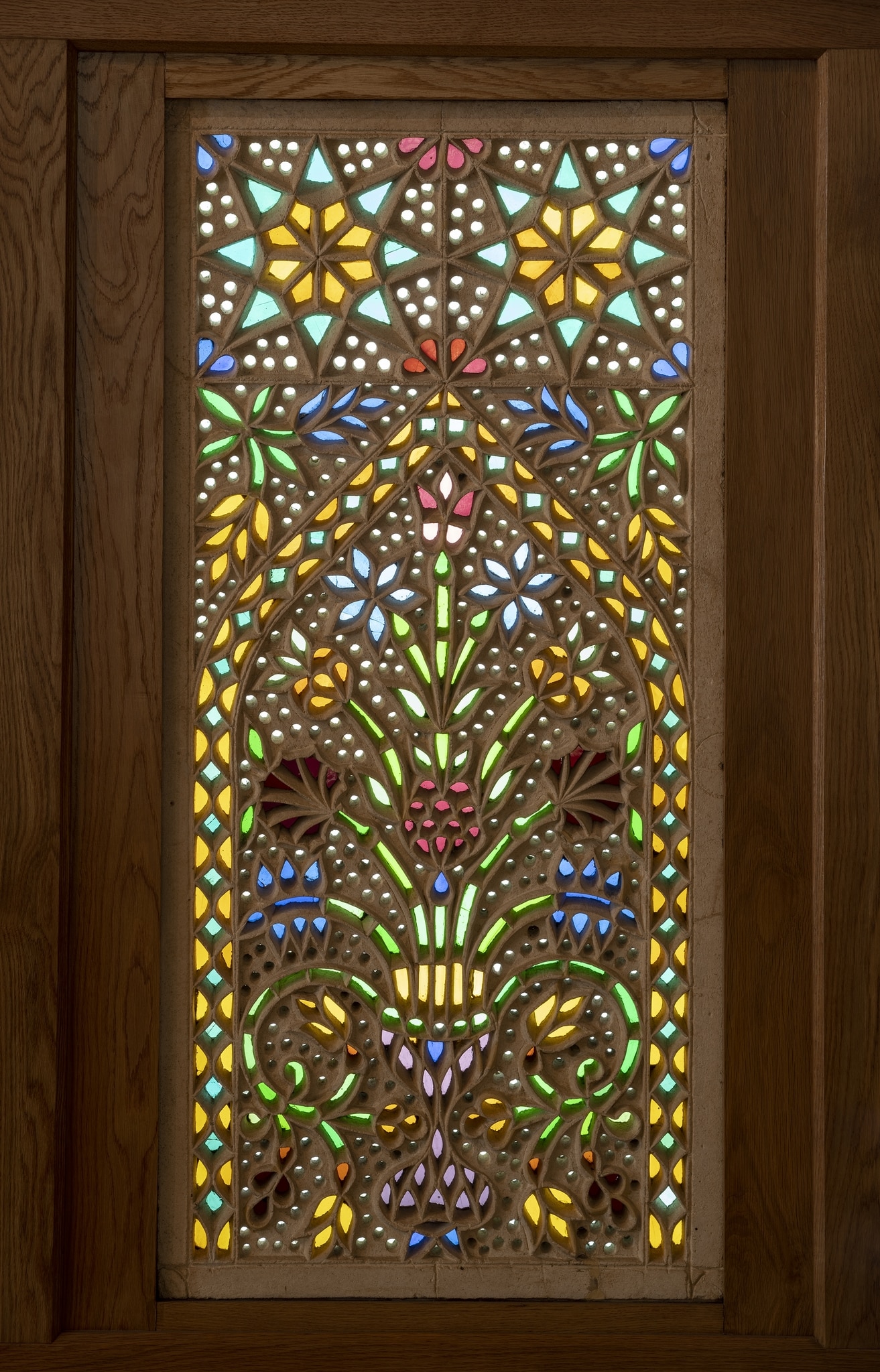
The flower-and-vase motif of this stucco and glass window is a late version of one of the standard motifs of qamariyya widespread in Egypt during the Ottoman period. The way in which the two lowest flowers with their curved stems are depicted differs from most of the examples of this type of window studied. A comparable, but less elaborate example is the Cairene window held at the Victoria and Albert Museum in London (MES.LOST.22). We have, however, no direct comparison for the flowers in the spandrels, which are much more elaborate than the floral motifs of most of the other windows.
The representation of flowers in a vase is a widespread motif in Islamic arts. It can be found in numerous other media, such as ceramics, wood panelling, wall paintings, and textiles, over a long period of time, and in both sacred and profane contexts. Depending on the quality of the design, the type of flower cannot always be identified. Among the most sophisticated examples of stucco and glass windows with the vase motif are those in the apartments of the Crown Prince at the Topkapı Sarayı (early 17th century CE, date of the windows uncertain) and those in the Sultan's Lodge (Hünkâr Kasrı) of the Yeni Cami (1661–1663 CE, date of the windows uncertain), both in Istanbul. Windows with this motif can also be found in several of the collections studied (see for instance IG_7, IG_166, IG_178, IG_255).
The motif aroused the interest of Western artists and architects, as is attested by a significant number of book illustrations, sketches, and paintings (see for instance IG_43, IG_118, IG_149, IG_153, IG_437, IG_443, IG_461), as well as by the replicas of such windows installed in Arab-style interiors across Europe (IG_54–IG_59, IG_64, IG_91, IG_431).
Windows IG_350 and IG_352 from the same museum collection have a comparable bipartite composition, but the panel with the stars is positioned below the main motif instead of above it, as in the window discussed here.
From a technical point of view, it can be assumed that the window was made in an Egyptian workshop. Although the rear of the window was not accessible during our examination, it can be concluded from the restoration report of 2004 that the window was made according to the traditional technique used in the manufacture of qamariyyāt in North Africa to this day (see Technique).
According to the museum records, the window dates to the 16th or 17th century. However, there are some indications that speak against this early date. On the one hand, the outline of the framing arch as well as the way in which the two lowest stems of the flower bouquet spiral downwards, suggest a later dating. On the other hand, the window was in a relatively good state of preservation before restoration in 2003, despite the poor weather resistance of the stucco lattice. If the window had been installed in a building in the 16th or 17th century and been exposed to the weather for two or three centuries, we would have expected it to be more heavily weathered before its restoration in 2003. Moreover, the pieces of glass show the characteristics of cylinder-blown sheet glass, a technique that was uncommon in the Islamic world at that time and more commonly used in Europe. Interestingly, the Hungarian architect Max Herz (1856–1819) states in 1902 that sheet glass was imported to Egypt from Europe from the 19th century, because local sheet-glass production had come to a standstill (Herz, 1902, p. 53).
The Cairo-based, Cypriot art and antique dealer Phokion Tanos (1898–1972) donated this window – along with 12 other qamariyyāt (11049–11059, 20969, 20960, see IG_336–359) – to the Benaki Museum in Athens, probably in the 1940s.