Bestelltes Bild

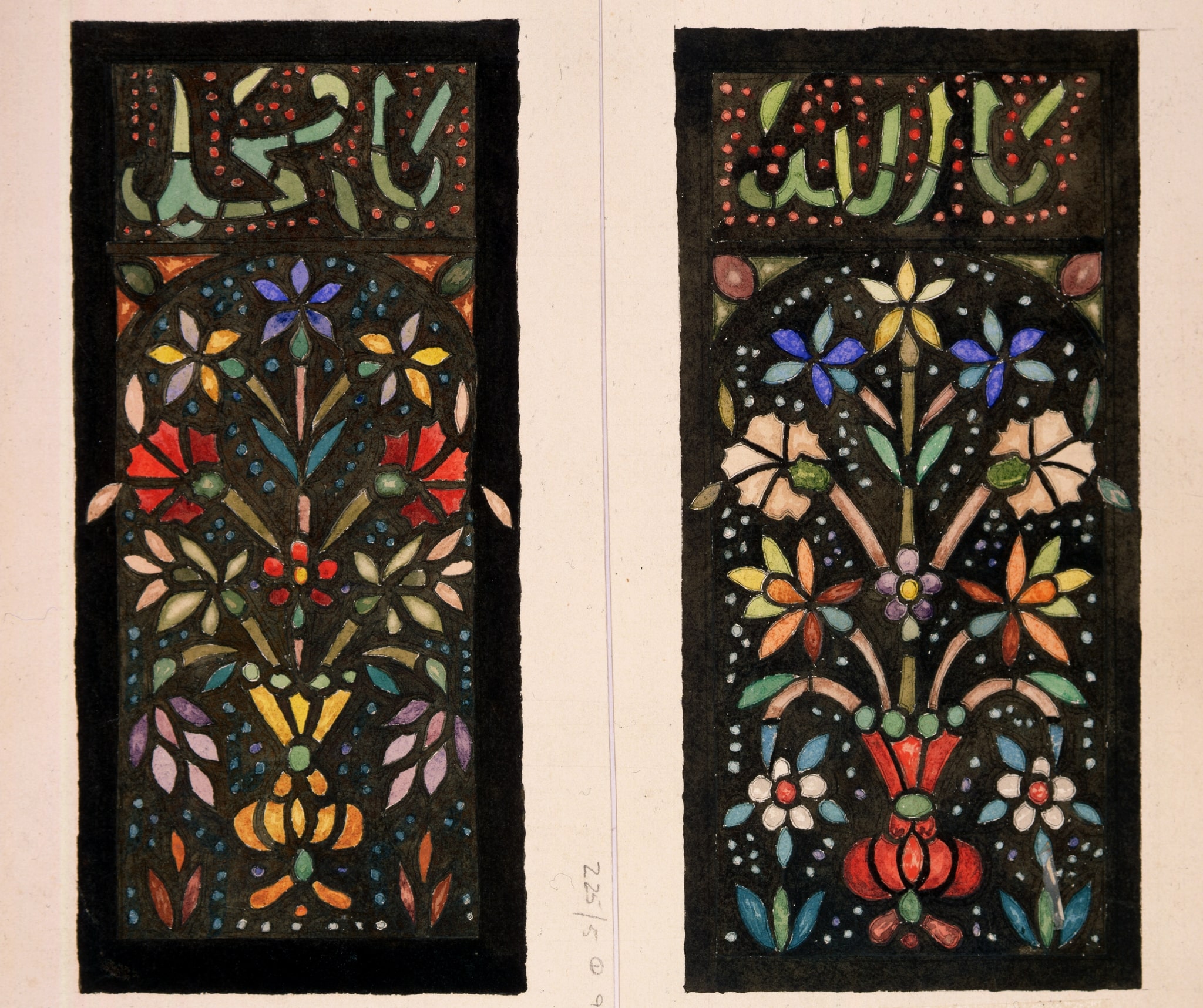
IG_50: Design for two stained glass windows of flowers and Arabic characters for Leighton House, 12 Holland Park Road, London
(GBR_London_RoyalInstituteOfBritishArchitects_IG_50)

Kontaktdaten

Bitte geben Sie Ihren Vornamen ein.
Bitte geben Sie Ihren Namen ein.
Bitte geben Sie Ihre E-Mail-Adresse ein.
Die E-Mail-Adresse ist ungültig.

Bitte machen Sie so viele Angaben wie möglich (Titel der Publikation, Datenbank, Herausgeber, Auflage, Erscheinungsjahr, usw.)

Das Vitrocentre Romont kann Ihnen nur eigene Bilder zur Verfügung stellen. Bilder von Dritten können wir Ihnen leider nicht überlassen. Betrifft Ihre Bestellung Fotografien von Drittparteien, senden wir Ihnen die Kontaktadresse, über welche die Bilder bezogen werden können.

Die von Ihnen in diesem Formular angegebenen Personendaten werden vom Vitrocentre Romont ausschliesslich für die Bearbeitung Ihrer Bildbestellung verwendet. Die Korrespondenz zur Bestellung wird zur internen Nachvollziehbarkeit archiviert. Die Daten werden weder für andere als die hier aufgelisteten Zwecke verwendet noch an Dritte weitergegeben. Durch das Absenden des Bestellformulars erklären Sie sich mit dieser Nutzung Ihrer Personendaten einverstanden.

Bei Fragen können Sie gerne eine E-Mail an info@vitrosearch.ch senden.

Titel

Design for two stained glass windows of flowers and Arabic characters for Leighton House, 12 Holland Park Road, London

Art des Objekts
Masse
47 x 31.75 cm
Künstler:in / Hersteller:in
Datierung
1870
Standort
Inventarnummer
SD101/7 (1-2), RIBA4031
Forschungsprojekt
Autor:in und Datum des Eintrags
Francine Giese, Laura Edmunds, Omar Anchassi 2025

Ikonografie

Beschreibung

Two sheets of paper, each with a design for a stucco and glass window. The designs differ only slightly in terms of the overall composition of the two windows and the colour of the glass. They are both composed of two main zones: a narrow upper zone with an Arabic inscription (see Inscription) backed with green glass, and a much larger lower zone with the main motif, consisting of nine flowers in a vase. The flowers are arranged symmetrically and depicted in a stylized manner; carnations, lilies, and hyacinths (left window only) are recognizable. The vase is flanked by a trifoliate plant on each side and framed by a semicircular arch. At the height of the carnations, petals extend into the uncarved edge area of the stucco panel. An egg-shaped element is placed in the centre of the spandrels. The flowers in a vase, the trifoliate plants, and the inscription are worked in relief against a perforated background, which is slightly recessed. The perforations are backed with coloured glass.

Iconclass Code
25G41(CARNATION) · Blumen: Nelke
25G41(LILY) · Blumen: Lilie
25G41(TULIP) · Blumen: Tulpe
41A6711 · Blumen in einer Vase
49L142 · arabische Schrift
49L8 · Inschrift, Aufschrift
Iconclass Stichworte
Inschrift

yā Allāh (O God)
yā Muḥammad (O Muḥammad)
(from right to left)
Arab Windows / Belonging to F. Leighton Esqre RA / Glass designed by G. Aitchison. Archt. s & d: George Aitchison / Feb. 15th 1870
(annotation recto/verso)

Signatur

February 1870

Materialien, Technik und Erhaltungszustand

Technik

Watercolour

Entstehungsgeschichte

Forschung

These designs for two stucco and glass windows to be installed in the east wall of the Studio extension of Leighton House at 12 Holland Park Road in Kensington (London) are signed by the British architect George Aitchison (1825–1910) and dated 15 February 1870. Aitchison was in charge not only of the extension, but of all five phases of construction executed on behalf of the Victorian artist and collector Frederic Leighton (1830–1896) between 1865 and 1895.

Leighton House is one of the most famous 19th-century artist’s homes, combining living, working, and exhibition spaces according to Leighton’s needs and aesthetic visions (Sweetman, 1988, pp. 189–192; Robbins/Suleman, 2005; Robbins, 2011; Anderson, 2011; Droth, 2011; Vanoli, 2012; Roberts, 2018; Gibson, 2020; Robbins, 2023). Leighton’s studio-house reflects the exotic taste of the time (Walkley, 1994, pp. 52–56), which finds close parallels in the now-lost studio of the British painter Frank Dillon (1832–1908). Dillon, who visited Cairo on several occasions in the 1850s – 1870s, recreated a Cairene interior with wall tiles, wooden furnishings, and two stucco and glass windows in his studio in Kensington (Conway, 1882, p. 196; Walkley, 1994, p. 70), as attested by a wood engraving published in the second volume of Georg Ebers’s Aegypten in Bild und Wort (Ebers, 1880, p. 96, see IG_117).

Although executed almost a decade before the famous Arab Hall (1877–1881), the Studio extension of Leighton House, constructed 1869–1870, can nevertheless be seen as a prelude to the Arab-style interior that was to follow. While Leighton was familiar with Islamic art and architecture through his travels to Sicily, Algeria, Turkey, Egypt, Syria, Spain, and Morocco, Aitchison was acquainted with Cairo, among other Islamic cities, where he examined traditional houses. According to contemporary sources, Leighton acquired various stucco and glass windows during his travels to Cairo (1868) and Damascus (1873) (see for instance Anon., 1880; Wright, 1896; Rhys, 1900). Unfortunately, the Egyptian windows were damaged during shipping (Rhys, 1900, p. 100), something that apparently happened on other occasions (see for instance IG_43). The glass fell off the stucco lattice and only part of it could be reused in the replica installed in the west wall of the Arab Hall (IG_56). All other windows had to be filled with ‘English imitations’ (Rhys, 1900, p. 100).

From these sources, we can conclude that initially it was planned to integrate original qamarīyāt in the Studio extension. However, damage occasioned during transport forced the patron and architect to change the plans and to use replicas made in Britain. Due to Aitchison’s first-hand knowledge of stucco and glass windows (Purdon Clarke & Hayter Lewis, 1881, pp. 173–174; Aitchison, 1904, p. 57), his designs have close similarities to traditional qamarīyāt. They are both composed of two main zones: an upper zone with the Arabic inscriptions, yā Allāh (‘O God’) and yā Muḥammad (‘O Muḥammad’) respectively, and a lower zone with the flowers-in-a-vase motif. Both designs have only minor differences compared with windows from Egypt. Nevertheless, the inscription backed with green instead of yellow glass and the perforations with coloured instead of clear glass, as well as the way in which the petals extend into the uncarved edge area of the stucco panel, reveal the hands of a Western designer.

Aitchison seems to have been involved intensively with stucco and glass windows and their execution in Britain at this time, as attested by a design for the Knoyle Schools in Semley (Wiltshire) conserved at the Royal Institute of British Architects (RIBA) attests. In this design (RIBA69211), also dated 1870, he envisaged the crowning element of a three-lancet window with the flower-in-a-vase motif, which clearly shows Aitchison’s familiarity with the foreign vocabulary, although, in this case, he translated the Islamic prototypes much more freely than in the two designs for the Studio extension.

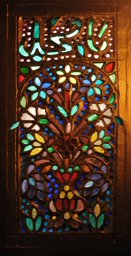
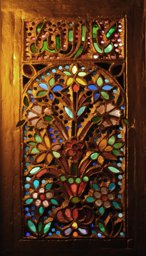
The two replicas IG_58 and IG_59 were made on the basis of the designs discussed here. While the windows follow the designs very closely in terms of iconography and style, they deviate in some places from the planned colour scheme.

Datierung
1870
Frühere Standorte
Verknüpfte Standorte
Herstellungsort

Provenienz

Eigentümer:in

Bibliografie und Quellen

Literatur

Aitchison, G. (1904). Coloured Glass. The Architectural Journal XI(3), pp. 53–65.

Anderson, A. (2011). The 'New Old School': Furnishing with Antiques in the Modern Interior–Frederic, Lord Leighton’s Studio-House and Its Collections. Journal of Design History, 24(4), 315–338.

Anon. (1880, October 1). Artists' Homes, No. 7. Sir Frederick Leighton's House and Studio. The Building News, 1880, p. 384.

Barringer, T., & Prettejohn, E. (eds.) (1999). Frederic Leighton: Antiquity Renaissance Modernity (Studies in British Art, 5). New Haven & London: Yale University Press.

Butler, V. (1893, July–December). An Hour at Sir Frederick Leighton's. Lippincott's Monthly Magazine. A Popular Journal of General Literature, Science, and Politics, III, 463–466.

Clarke, C. P., & Hayter Lewis, T. (1881). Persian Architecture and Construction. Transactions of the Royal Institute of British Architects, Session 1880–1881 (pp. 161–174). London: Royal Institute of British Architects.

Conway, M. D. (1882). Travels in South Kensington with Notes on Decorative Art and Architecture in England. London: Trübner & Co.

Droth, M. (2011). Leighton's House: Art In and Beyond the Studio. Journal of Design History, 24(4), 339–358.

Ebers, G. (1880). Aegypten in Bild und Wort. Dargestellt von unseren ersten Künstlern, vol. 2. Stuttgart: Eduard Hallberger.

Edwards, J. (2010). The Lessons of Leighton House: Aesthetics, Politics, Erotics. In Rethinking the Interior, c. 1867–1896. Aestheticism and Arts and Crafts (pp. 85–110). Farnham: Ashgate.

Gibson, M. (2020). ‘An Oriental Kiosk’: The Building of the ‘Arab Hall’ at Leighton House in London. Orientations, 51(2), 2–15.

Rhys, E. (1900). Frederic Lord Leighton. An Illustrated Record of His Life and Work. London.

Robbins, D. (2011). Leighton House Museum. Holland Park Road, Kensington. The Royal Borough of Kensington and Chelsea.

Robbins, D. (2023). Leighton House. Step into a painter's world. The Royal Borough of Kensington and Chelsea.

Robbins, D. (ed.) (2010). Closer to Home. The Restoration of Leighton House and Catalogue of the Reopening Displays. The Royal Borough of Kensington and Chelsea, 2010.

Robbins, D., & Suleman, R. (2005). Leighton House Museum. Holland Park Road, Kensington. The Royal Borough of Kensington and Chelsea Museums and Arts Service.

Roberts, M. (2018). The Resistant Materiality of Frederic Leighton’s Arab Hall. British Art Studies 9. https://dx.doi.org/10.17658/issn.2058-5462/ issue-09/mroberts

Stone, J. H. (1905, October). Leighton House. The English Illustrated Magazine, 3–17.

Sweetman, J. (1988). The Oriental obsession. Islamic inspiration in British and American art and architecture 1500–1920. Cambridge: Cambridge University Press.

Walkley, G. (1994). Artists' Houses in London 1764–1914. Aldershot: Scolar Press.

Wright, W. (1896). Lord Leighton at Damascus and After. The Bookman, March 1896, 183–185.

Bildinformationen

Name des Bildes
GBR_London_RoyalInstituteOfBritishArchitects_IG_50
Fotonachweise
RIBA Collections

Weiteres Bildmaterial und verwandte Objekte

Verwandte Objekte
Replica of a stucco and glass window with flowers in a vase and inscription

Zitiervorschlag

Giese, F., Edmunds, L., & Anchassi, O. (2025). Design for two stained glass windows of flowers and Arabic characters for Leighton House, 12 Holland Park Road, London. In Vitrosearch. Aufgerufen am 5. Dezember 2025 von https://www.vitrosearch.ch/objects/2712894.

Informationen zum Datensatz

Referenznummer
IG_50