Image commandée

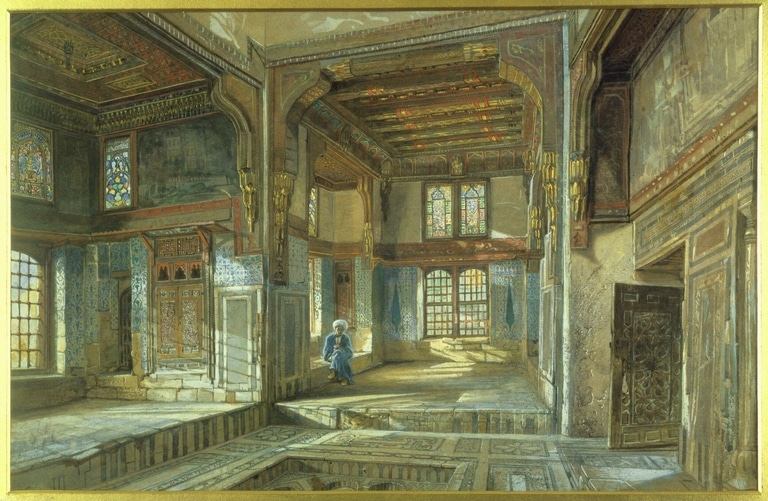
IG_98: Interior of the House of the Mufti Sheikh El Mahadi, Cairo
(GBR_London_VAM_IG_98)

Coordonnées

Prière de compléter le champ "Prénom".
Prière de compléter le champ "Nom".
Prière de compléter le champ "E-Mail".
Votre adresse e-mail n'est pas valide.

Veuillez s’il vous plaît indiquer autant d’informations que possible (titre de la publication, base de données, éditeur, nombre d’exemplaires, année de parution, etc.)

Le Vitrocentre Romont ne peut mettre à votre disposition que ses propres images. Nous ne pouvons malheureusement pas vous fournir des images de tiers. Si votre commande concerne des photographies de tiers, nous vous enverrons volontiers l'adresse de contact où vous pourrez obtenir les images.

Les données personnelles que vous avez indiquées dans ce formulaire sont utilisées par le Vitrocentre Romont exclusivement pour le traitement de votre commande d'images. La correspondance relative à la commande est archivée à des fins de traçabilité interne. Les données ne seront utilisées à aucune autre fin que celles énumérées ici, ni transmises à des tiers. En envoyant un formulaire de commande, vous acceptez tacitement cette utilisation de vos données personnelles.

Pour toute question complémentaire, veuillez contacter info@vitrosearch.ch.

Titre

Interior of the House of the Mufti Sheikh El Mahadi, Cairo

Type d'objet
Dimensions
30.5 x 47 cm
Artiste
Datation
c. 1873
Lieu
Numéro d'inventaire
853-1900
Projet de recherche
Auteur·e et date de la notice
Sarah Tabbal 2024

Iconographie

Description

Several multi-coloured stucco and glass windows can be seen in the watercolour by Frank Dillon (1832–1908) Interior of the House of the Mufti Sheikh El Mahadi, Cairo, which was finished around 1872 (Anonymous 1872, p. 183). The British Orientalist painter Dillon depicted this private interior with a man wearing a white turban and a blue robe, sitting in one of the more elevated side recesses (Thomas, 2013, pp. 59–60). The domestic room is divided into several sections: there is a central square basin in the foreground, adjacent to which two more elevated side recesses are shown. The interior is richly decorated, with a marble floor with manifold intarsia patterns, white-blue ceramic tiles on the walls, and a wood-panelled ceiling with painted ornamentation. On the right side of the watercolour, there is an open wooden door decorated with geometric star ornament. Several stucco and glass windows can be seen in the painting: on the left, there is a window with the motif of a vase of flowers and another with geometric ornament next to a mural painting, as well as two further windows in the central recess with geometric ornamentation. The windows allow plenty of daylight to enter the interior, creating a play of light, shadow, and colour.

Code Iconclass
41A2 · intérieur de maison
41A33 · fenêtre
48C1412 · l'intérieur ~ représentation d'un édifice
Mot-clés Iconclass

Matériaux, technique et état de conservation

Technique

Watercolour on paper.

Historique de l'oeuvre

Recherche

This interior depicted by Frank Dillon represents the mandarah in the ‘House of the Mufti’ in Cairo – so named because it was owned by the supreme mufti of Egypt, Sheikh Muhammad al-ʿAbbasi al-Mahdi (1827–1897) between 1847 and 1886 (Llewellyn, 1998, p. 154). During the 19th century, Europeans had become familiar with the term mandarah through Edward William Lane: ‘In general, there is, on the ground-floor, an apartment called a mun’dar’ah, in which male visitors are received’ (Lane, 1836, p. 11). According to Mercedes Volait, the ‘House of the Mufti’ was built at the beginning of the 18th century, between 1704 and 1705 (a date that can be found on a column in the residence) and had been given to Sheikh al-ʿAbbasi when he became Grand Mufti in 1848 (Volait, 2021, p. 119). Dillon travelled to Egypt several times in the 1850s to the 1870s and visited the house while he was in Cairo (Thomas, 2013, pp. 59–60). One of his drawings of the house is dated 26 December 1873 (Victoria and Albert Museum, 856-1900).
Dillon’s watercolour was reviewed by numerous contemporary art critics: the London-based The Art Journal reported on the authenticity of Dillon’s work: ‘The picture represents the liwan or daïs of a Cairo house; and every minutest detail is worked out by the painter with the strictest fidelity, which does not, however, exclude artistic management of brilliant hues of colour.’ (Anonymous, 1873, p. 239). In the London-based literary magazine The Athenaeum, Dillon’s watercolour was lauded by the Anglo-Indian official and writer Sir George Christopher Molesworth Birdwood (1832–1917): ‘Mr. F. Dillon has not before represented Oriental interiors so successfully as in House of the Mufti Sheikh el Mahadi, Cairo (37), a sunlit interior, with latticed windows, tiled walls, carpet-laden floors, couches, and the like. This is brilliantly and delicately painted, with unusual clearness and breadth of light and colour. The figures are unworthy of the rest of the work, for they are incorrectly drawn and rather clumsily painted.’ (Birdwood, 1874, p. 582). The windows in the Sheikh’s house received the attention of Dillon’s contemporary, Richard Phené Spiers (1838–1916), who described them as follows: ‘In the House of the Mufti the mandarah is lighted by windows on three sides of the principal decision, and also, in the upper portion of the durka’ah, by windows known as ‘kamareeyehs,’ which are formed of pieces of coloured glass sunk in an arabesque pattern, in which gypsum takes the place of lead, as in our leaded lights or windows.’ (Spiers, 1890, p. 236).
The watercolour was widely disseminated at the end of the 19th century: it was reproduced in 1880 with the title Mandara des Mufti (Schech el-Mahdi) as a wood engraving in Aegypten in Bild und Wort (Stuttgart and Leipzig: Hallberger 1880, vol. 2, p. 89) (IG_152) by the German Egyptologist and novelist Georg Ebers (1837–1898).
In a broader context, the ‘House of the Mufti’ became a popular painting subject for artists travelling to Egypt during the 19th century. It was painted, for example, by Theodor Zeerleder (IG_471, IG_473), František Schmoranz (IG_415), and Franz von Lehnbach (Palastinterieur in Kairo, 1876, oil on board, 88 × 70cm, Lenbach-Nachlass im Familienbesitz, reproduced in Baranow 1986, p. 130). The Sheikh’s house was also documented in a contemporary photograph by an anonymous artist, in which a stucco and glass window is partially visible on the right side of the picture (IG_476). Dillon also depicted the Sheikh’s house in another watercolour (IG_99).‬‬‬‬

Datation
c. 1873
Période
1873 – 1874
Sites liées
Lieu de production

Provenance

Bibliographie et sources

Bibliographie

Anonymous (1872). The Royal Academy. The One Hundred and Fourth Exhibition. The Art Journal, new series, volume XI, 181–186.

Anonymous (1873). Exhibition of the Royal Academy. The Art Journal 12, 236–241.

Baranow, S. von (1986). ‪Franz von Lenbach: Leben und Werk. Köln: DuMont.‬‬‬

Birdwood, G. (1874). Fine Arts. The Athenaeum, October 31, 582–584.

Ebers, G. (1880). Aegypten in Bild und Wort. Dargestellt von unseren ersten Künstlern. Vol. 2. Stuttgart: Eduard Hallberger.

Lane, E. W. (1836). An Account of the Manners and Customs of the Modern Egyptians. London: Charles Knight & Co.

Llewellyn, B. (1998). Two Interpretations of Islamic Domestic Interiors in Cairo: J. F. Lewis and Frank Dillon. In Travellers in Egypt, ed. Paul Starkey and Janet Starkey. London and New York: Tauris, 148–56.

Spiers, R. P. (1890). Notes by R. Phené Spiers, F.S.A., Member of Council. Transactions of the Royal Institute of British Architects, vol. VI., London: Published at the Royal Institute of British Architects, 221–242.

Thomas, A. (2013). James Wild, Cairo and the South Kensington Museum. In M. Volait (ed.), Le Caire dessiné et photographié au XIXe* *siècle (pp. 41–68). Paris: Picard.

Tromans, N. (ed.) (2008). The Lure of the East: British Orientalist Painting. London: Tate Publishing.

Volait, M. (2021). Antique Dealing and Creative Reuse in Cairo and Damascus 1850–1890. Leiden: Brill.

Informations sur l'image

Nom de l'image
GBR_London_VAM_IG_98
Crédits photographiques
© Victoria and Albert Museum, London
Lien vers l'image originale

Proposition de citation

Tabbal, S. (2024). Interior of the House of the Mufti Sheikh El Mahadi, Cairo. Dans Vitrosearch. Consulté le 5 décembre 2025 de https://www.vitrosearch.ch/objects/2712942.

Informations sur l’enregistrement

Numéro de référence
IG_98