Recherche
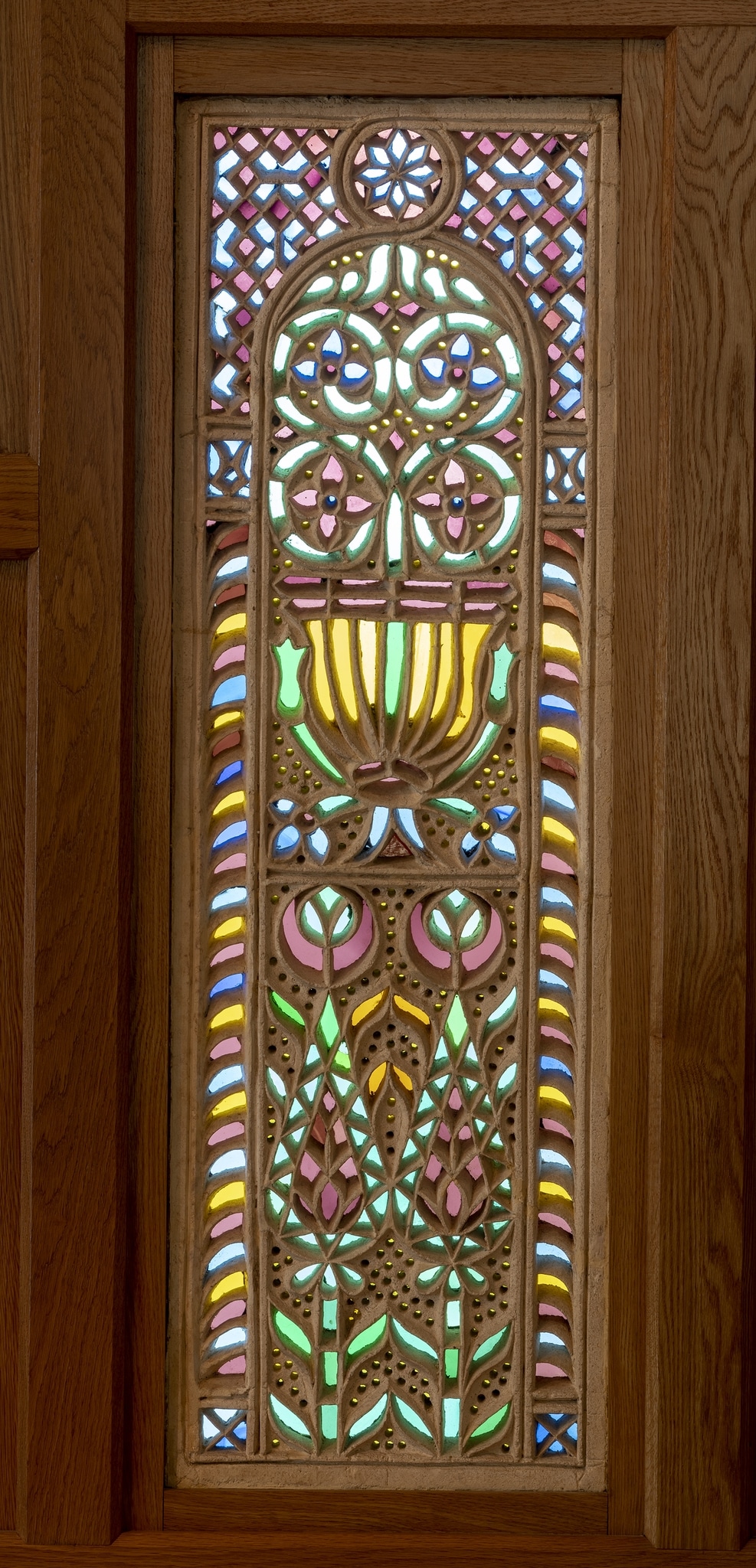
This stucco and glass window, which has a largely identical counterpart in IG_355, also held at the Benaki Museum of Islamic Art, stands out from most of the examples studied. Although it combines two of the most common motifs of stucco and glass windows, it differs significantly in the way these motifs are represented. The cypress trees (in the lower half of the window) are not entwined with tendrils as is usually the case in windows with this motif. The flowers-in-a-vase motif (upper half) differs from the standard representation in that the vase does not contain a bouquet composed of different flowers, but holds two spiral tendrils, which are strongly reminiscent of the Umayyad mosaics of the Dome of the Rock in Jerusalem. Also, the architectural frame is hardly found in any of the specimens examined (except IG_359 in the same museum). However, it is a common element in medieval book illumination, for example.
From a technical point of view, it can be assumed that this bipartite window was executed by a local workshop, most probably in Egypt. Although the rear of the window was not accessible during our examination, it can be concluded from the restoration report of 2004 that the window was made according to the traditional technique used in the manufacture of qamariyyāt in North Africa to this day (see Technique).
According to the museum records, the window dates to the 16th or 17th century. However, there are some indications that speak against this early date. On the one hand, the unusual representation of the two motifs, which could be the result of historicist tendencies, suggests a later dating. On the other hand, the window was in a relatively good state of preservation before the restoration in 2003, despite the poor weather resistance of the stucco lattice. If the window had been installed in a building in the 16th or 17th century and been exposed to the weather for two or three centuries, we would have expected it to be more heavily weathered before its restoration in 2003. Moreover, the pieces of glass show the characteristics of cylinder-blown sheet glass, a technique that was uncommon in the Islamic world at that time and more commonly used in Europe. Interestingly, the Hungarian architect Max Herz (1856–1819) states in 1902 that sheet glass was imported to Egypt from Europe from the 19th century, because local sheet-glass production had come to a standstill (Herz, 1902, p. 53).
The Cairo-based, Cypriot art and antique dealer Phokion Tanos (1898–1972) donated this window – along with 12 other qamariyyāt (11049–11059, 20969, 20960, see IG_336–359) – to the Benaki Museum in Athens, probably in the 1940s.
Datation
early 13th–early 14th centuries AH / 19th century CE
Période
1800 – 1900
Sites antérieures
Lieu de production