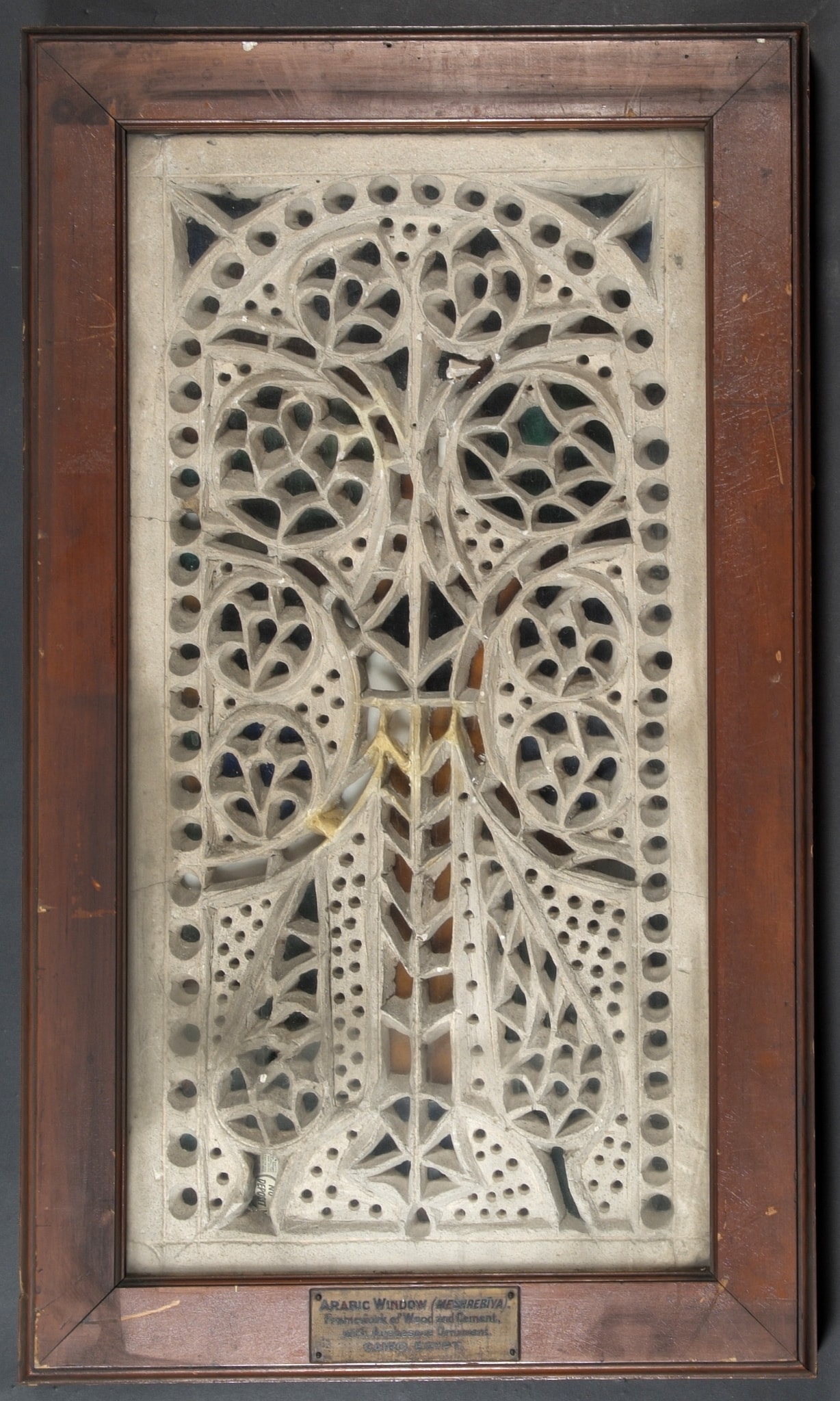
This stucco and glass window corresponds iconographically and technically to one of the standard types of qamariyya widespread in Egypt during the Ottoman period. In contrast to other windows with the representations of the Tree of Life, this example shows a much more abstract version of the motif. It is therefore not possible to say with certainty whether the attribution is correct.
The representation of the Tree of Life has a long tradition across time and cultures. It can also be found in the Islamic world, where the tree that flourishes in paradise, called ṣidrat al-muntahā or ṭūbā, alludes to the Tree of Immortality described in the Qurʾan (20:120). Representations in various media, including ceramics, textiles, mosaics, murals, and stone or wood carvings, highlight the widespread use of the motif in the Islamic realm.
Windows showing the same motif can be found in Delort de Gléon’s collection of Islamic art, bequeathed by the collector’s wife Marie Augustine Angélina Delort de Gléon to the Musée du Louvre in 1912 (Delort de Gléon, 1914); see for instance IG_6, IG_8, IG_16, IG_21, IG_24, IG_28. Due to the strong stylization of the motif, however, this window clearly differs from the examples in the Louvre. The almost ornamental design of the leaf crown, for example, has no parallel in the Louvre windows.
According to the museum records, this window forms part of a lot of six qamariyyāt (IG_288–293) acquired by the Glasgow Museums in London in 1896 from the Pre-Raphaelite painter, writer, and collector Henry Wallis (1830–1916). Wallis was an expert in Islamic art and especially ceramics, as several of his publications attest (see for instance Wallis 1885, Wallis 1893, Wallis 1894, Wallis 1899). Due to the lack of documentation, we do not know where Wallis acquired the windows. The manufacturing technique, however, suggest that the window was made in an Egyptian workshop. The composition of the glass provides evidence that indirectly supports this hypothesis. Six pieces of glass (of amber and green colour) were chemically examined and found to be plant-ash glass. At least two of the pieces of glass (both of turquoise colour) were cut from discs of crown glass. The production of sheet glass using the crown-glass process and using plant ash as a flux was widespread in the Islamic world.
According to the Hungarian architect Max Herz (1856–1819), however, the production of flat glass in Egypt had come to a standstill in the 19th century, and flat glass was imported from Europe (Herz, 1902, p. 53). If this is correct, then the window must have been made before the 19th century. One argument in favour of a pre-19th-century date is the poor state of preservation of the window, which suggests that the window was once installed in a building and was not produced directly for the art market, as other windows (e.g. IG_254–257, IG_170). The stylized representation of the motif, however, contradicts a dating before the 19th century. As far as the glass is concerned, it is possible that older glass was reused in the manufacture of this window.