Bestelltes Bild

IG_291: Stucco and glass window (?)
(GBR_Glasgow_GlasgowMuseumsCollection_IG_291)

Kontaktdaten

Bitte geben Sie Ihren Vornamen ein.
Bitte geben Sie Ihren Namen ein.
Bitte geben Sie Ihre E-Mail-Adresse ein.
Die E-Mail-Adresse ist ungültig.

Bitte machen Sie so viele Angaben wie möglich (Titel der Publikation, Datenbank, Herausgeber, Auflage, Erscheinungsjahr, usw.)

Das Vitrocentre Romont kann Ihnen nur eigene Bilder zur Verfügung stellen. Bilder von Dritten können wir Ihnen leider nicht überlassen. Betrifft Ihre Bestellung Fotografien von Drittparteien, senden wir Ihnen die Kontaktadresse, über welche die Bilder bezogen werden können.

Die von Ihnen in diesem Formular angegebenen Personendaten werden vom Vitrocentre Romont ausschliesslich für die Bearbeitung Ihrer Bildbestellung verwendet. Die Korrespondenz zur Bestellung wird zur internen Nachvollziehbarkeit archiviert. Die Daten werden weder für andere als die hier aufgelisteten Zwecke verwendet noch an Dritte weitergegeben. Durch das Absenden des Bestellformulars erklären Sie sich mit dieser Nutzung Ihrer Personendaten einverstanden.

Bei Fragen können Sie gerne eine E-Mail an info@vitrosearch.ch senden.

Titel

Stucco and glass window with a Tree of Life

Art des Objekts
Masse
95 x 54 x 3.5 cm (with frame); 84 x 43 x 2.5 cm (without frame)
Künstler:in / Hersteller:in
Herstellungsort
Datierung
early 13th–early 14th centuries AH / 19th century CE
Standort
Lage
storage
Inventarnummer
1896.46.6
Forschungsprojekt
Autor:in und Datum des Eintrags
Francine Giese, Sophie Wolf 2025

Ikonografie

Beschreibung

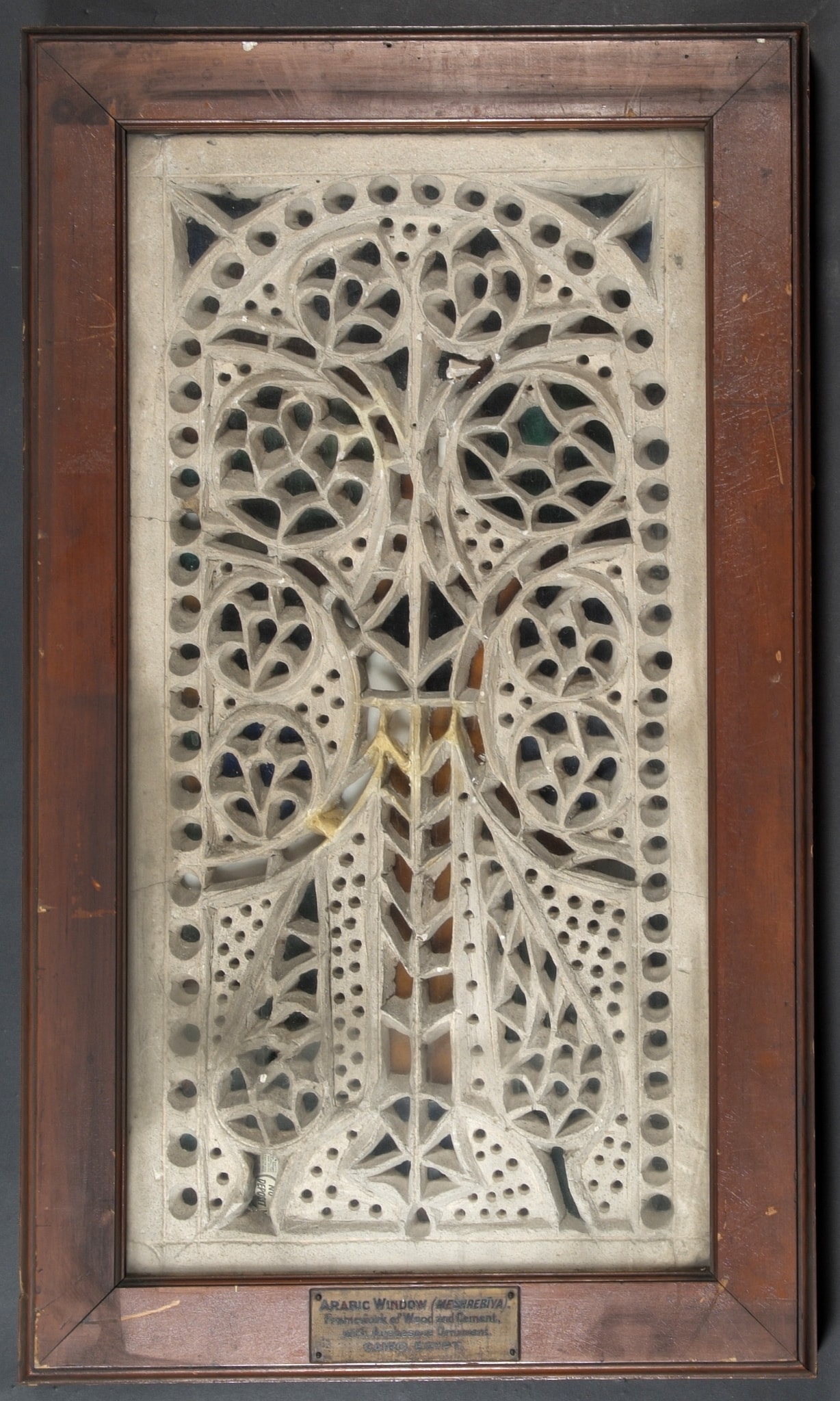
The main motif of this stucco and glass window is a tree with leaves, which are grouped into eight, symmetrically arranged, round clusters. The clusters on each side are framed by two intertwined semicircular arches. The trunk of the tree rests on a semicircular elevation with a geometric design. It is flanked by two cypress trees. The motif is framed by a dotted arch. Triangles are set in the spandrels above the arch. The main design is worked out in relief against a slightly recessed perforated background.

The window with its original wooden frame is mounted in another wide wooden frame with glass protection.

Iconclass Code
25G3(+32) · Bäume (+ Blumen, Blüten, blühende Pflanzen)
25G3(CYPRESS) · Bäume: Zypresse
Iconclass Stichworte
Baum · blühen · Blume · Blüte · Zypresse

Materialien, Technik und Erhaltungszustand

Materialien

Gypsum plaster; colourless glass; coloured glass (three shades of green, turquoise, two shades of blue, two shades of orange colour, purple)

Technik

Latticework carved into a rectangular stucco panel and inlaid with colourless and coloured sheet glass. The pieces of glass are fixed on the back of the lattice with a thin layer of gypsum plaster. This layer is 1mm thick. The average thickness of the stucco panel is 25mm. The stucco panel was cast in a wooden frame measuring c.55 × 55 × 35mm. The frame is stained dark brown.

The design of the latticework has two levels: the main motif (level 0) has been carved out of the stucco panel with sharp, knife-like tools following a template incised in the surface of the panel. Traces of the incisions are still visible in some places on the front. The second level (level –1) shows irregularly spaced, slightly conical perforations. The holes were pierced with a metal or wooden pin in the stucco before it was fully set. All holes are backed with colourless glass. The main design and the perforations have been worked in such a way that the incident light is directed slightly downwards into the room.

The glass is either colourless or coloured in the mass. The pieces of glass were cut according to the design of the latticework using a glass cutter, leaving scratch marks on some of them. Two turquoise pieces of glass show concentric lines on the surface. One of the two pieces has a rounded and folded rim typical of crown glass. Some of the other coloured pieces of glass show small, elongated bubbles and relatively smooth surfaces. The pieces of glass are all c.2mm thick.

Erhaltungszustand und Restaurierungen

The front of the latticework shows cracks and losses. Some of the losses have been repaired with yellowish plaster. Several of the pieces of glass are missing, along with the plaster layer embedding them.

Residues of fibre and adhesive indicate that the back of the panel was once covered by a coarse fabric. It is not documented why and when the textile was attached. However, it can be assumed that it was glued to the rear of the panel to prevent further glass loss and to stabilize the latticework. It is possible that the measure dates from the late 19th century and was done to secure the window for transportation, better handling, and maybe display. Two other windows held at Glasgow Museums were treated the same way (IG_289, IG_290). In these windows, the textile is still attached to the back of the panel.

Entstehungsgeschichte

Forschung

This stucco and glass window corresponds iconographically and technically to one of the standard types of qamariyya widespread in Egypt during the Ottoman period. In contrast to other windows with the representations of the Tree of Life, this example shows a much more abstract version of the motif. It is therefore not possible to say with certainty whether the attribution is correct.

The representation of the Tree of Life has a long tradition across time and cultures. It can also be found in the Islamic world, where the tree that flourishes in paradise, called ṣidrat al-muntahā or ṭūbā, alludes to the Tree of Immortality described in the Qurʾan (20:120). Representations in various media, including ceramics, textiles, mosaics, murals, and stone or wood carvings, highlight the widespread use of the motif in the Islamic realm.

Windows showing the same motif can be found in Delort de Gléon’s collection of Islamic art, bequeathed by the collector’s wife Marie Augustine Angélina Delort de Gléon to the Musée du Louvre in 1912 (Delort de Gléon, 1914); see for instance IG_6, IG_8, IG_16, IG_21, IG_24, IG_28. Due to the strong stylization of the motif, however, this window clearly differs from the examples in the Louvre. The almost ornamental design of the leaf crown, for example, has no parallel in the Louvre windows.

According to the museum records, this window forms part of a lot of six qamariyyāt (IG_288–293) acquired by the Glasgow Museums in London in 1896 from the Pre-Raphaelite painter, writer, and collector Henry Wallis (1830–1916). Wallis was an expert in Islamic art and especially ceramics, as several of his publications attest (see for instance Wallis 1885, Wallis 1893, Wallis 1894, Wallis 1899). Due to the lack of documentation, we do not know where Wallis acquired the windows. The manufacturing technique, however, suggest that the window was made in an Egyptian workshop. The composition of the glass provides evidence that indirectly supports this hypothesis. Six pieces of glass (of amber and green colour) were chemically examined and found to be plant-ash glass. At least two of the pieces of glass (both of turquoise colour) were cut from discs of crown glass. The production of sheet glass using the crown-glass process and using plant ash as a flux was widespread in the Islamic world.

According to the Hungarian architect Max Herz (1856–1819), however, the production of flat glass in Egypt had come to a standstill in the 19th century, and flat glass was imported from Europe (Herz, 1902, p. 53). If this is correct, then the window must have been made before the 19th century. One argument in favour of a pre-19th-century date is the poor state of preservation of the window, which suggests that the window was once installed in a building and was not produced directly for the art market, as other windows (e.g. IG_254–257, IG_170). The stylized representation of the motif, however, contradicts a dating before the 19th century. As far as the glass is concerned, it is possible that older glass was reused in the manufacture of this window.

Datierung
early 13th–early 14th centuries AH / 19th century CE
Zeitraum
1800 – 1899
Frühere Standorte
Herstellungsort

Provenienz

Eigentümer:in
Seit 1896: Glasgow Museums, Inventar-Nr.: 1896.46.6, Sammlung (Zugriffsdatum: 21.11.2024), Glasgow (Vereinigtes Königreich)
Vorbesitzer:in
Von [Eingangsjahr unbekannt] bis 1896: Henry Wallis, London (Vereinigtes Königreich)

Bibliografie und Quellen

Literatur

Delort de Gléon, M. A. A. (1914, March 9). Legs de la collection de M. Delort de Gléon. Cote 20144787/17, Archives de musées nationaux (AMN), Archives nationales, Pierrefitte-sur-Seine.

Herz, M. (1902). Le musée national du Caire. Gazette des Beaux-Arts, 3. Pér. 28, 45–59, 497–505.

Wallis, H. (1885). Catalogue of specimens illustrative of Persian and Arab art exhibited in 1885 (Burlington Fine Arts Club), London.

Wallis, H. (1893). Typical examples of Persian and Oriental ceramic art, London.

Wallis, H. (1894). The Godman collection. Persian ceramic art belonging to Mr. F. DuCane Godman, F.R.S.; with examples from other collections. The thirteenth century lustred wall-tiles, London.

Wallis, H. (1899). Persian lustre vases, London.

Bildinformationen

Name des Bildes
GBR_Glasgow_GlasgowMuseumsCollection_IG_291
Fotonachweise
© CSG CIC Glasgow Museums Collection

Zitiervorschlag

Giese, F., & Wolf, S. (2025). Stucco and glass window with a Tree of Life. In Vitrosearch. Aufgerufen am 5. Dezember 2025 von https://www.vitrosearch.ch/objects/2713135.

Informationen zum Datensatz

Referenznummer
IG_291