Recherche
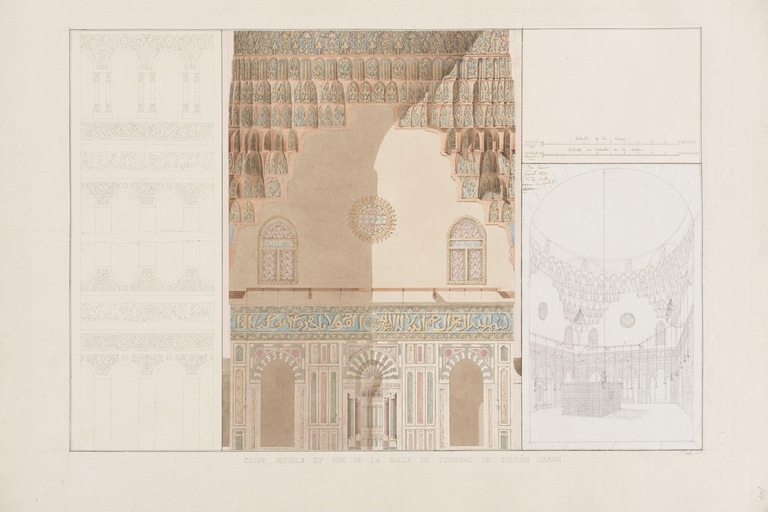
Between 1818 and 1827, Pascal Coste documented the buildings in Cairo extensively, among them the Sultan Hasan Mosque (757–764 AH / 1356–1363 CE). Two preparatory works for his publication Architecture arabe ou Monuments du Kaire, Mesurés et Dessinés, de 1818 à 1826 (1837) are dedicated to the windows of this mausoleum (see IG_202). The present drawing shows the qibla wall lightly coloured. This colouring corresponds only approximately to the colour indications of a sketch made of the round arch windows (IG_294). So, for instance, the blank round pieces of glass indicated appear in a reddish colour.
In 1827, before leaving Egypt, Pascal Coste sold 61 of his drawings to the Scottish Egyptologist Robert Hay (1799–1863), as well as exclusive rights to all his notes and drawings, on condition that he publishes them by 1830 at the latest. Coste kept copies of the drawings. Protracted negotiations between Hay, Coste, and Edward William Lane, acting as intermediary, followed. Eventually communications between Coste and Hay broke down. Coste had to look for another publisher and only in 1837, his own set of the Cairo drawings was published (Coste, 1878, p. 44; Volait, 1998, pp. 105–106; Darby, 1983, p. 31).
The 61 original drawings were never published and entered in 1985 the collection of the Victoria and Albert Museum.
The windows of the mausoleum of the Sultan Hasan Mosque were remade on the model of the old ones in 1906 (see Related Location).
Circular stucco and glass windows have a long tradition, going back to Ayyubid and Mamluk times (see Flood, 1993, p. 83, fig. 40, 44). In Cairene mosques, they were often placed above the mihrab (see IG_188).
Datation
1822
Sites liées
Lieu de production