Image commandée

IG_495: Stucco and glass window with inscription
(DEU_Hamburg_MuseumFuerKunstUndGewerbe_IG_495_1)

Coordonnées

Prière de compléter le champ "Prénom".
Prière de compléter le champ "Nom".
Prière de compléter le champ "E-Mail".
Votre adresse e-mail n'est pas valide.

Veuillez s’il vous plaît indiquer autant d’informations que possible (titre de la publication, base de données, éditeur, nombre d’exemplaires, année de parution, etc.)

Le Vitrocentre Romont ne peut mettre à votre disposition que ses propres images. Nous ne pouvons malheureusement pas vous fournir des images de tiers. Si votre commande concerne des photographies de tiers, nous vous enverrons volontiers l'adresse de contact où vous pourrez obtenir les images.

Les données personnelles que vous avez indiquées dans ce formulaire sont utilisées par le Vitrocentre Romont exclusivement pour le traitement de votre commande d'images. La correspondance relative à la commande est archivée à des fins de traçabilité interne. Les données ne seront utilisées à aucune autre fin que celles énumérées ici, ni transmises à des tiers. En envoyant un formulaire de commande, vous acceptez tacitement cette utilisation de vos données personnelles.

Pour toute question complémentaire, veuillez contacter info@vitrosearch.ch.

Titre

Stucco and glass window with inscription

Type d'objet
Dimensions
48.5 x 80 x 2 cm (with frame) ; 38 x 69.5 x 1.8 cm (without frame, the thickness varies between 1.5–1.8 cm)
Lieu de production
Datation
early 12th–early 14th century AH / 18th–19th century CE
Lieu
Numéro d'inventaire
1908.48 c
Projet de recherche
Auteur·e et date de la notice
Francine Giese, Sophie Wolf 2025

Iconographie

Description

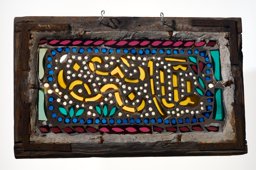
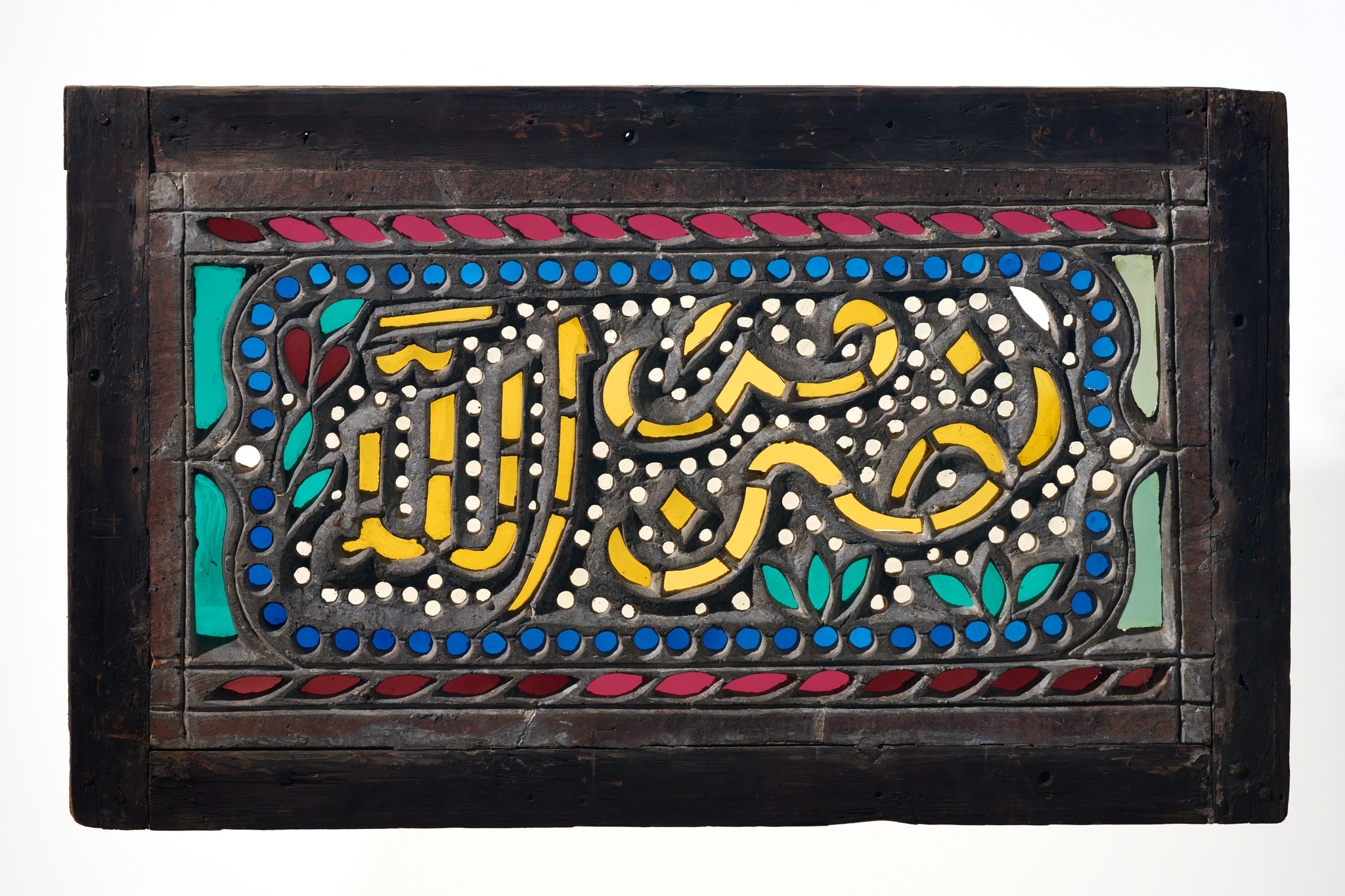
The stucco and glass window shows an Arabic inscription, representing the phrase naṣr min Allāh. The letters are worked in relief against a perforated background and set in a cartouche-like frame. They are backed with yellow glass. The empty spaces around the inscription are decorated with a flower and several leaves.

The window is preserved in its original wooden frame. The frame consists of wooden slats that are joined together at the corners. Metal brackets attached to the back of the frame reinforce its structure. Two new eyebolts are screwed into the wood at the top edge of the frame (left and right). There are traces of red paint along the front edges of the plaster panel.

Code Iconclass
49L142 · écriture arabique
49L8 · inscription
Mot-clés Iconclass
Inscription

naṣr min Allāh (with a help from God)

Matériaux, technique et état de conservation

Matériaux

Coarse-grained gypsum plaster; colourless glass; coloured glass (green, blue, yellow, and red flashed glass); wood; metal; red paint

Technique

Latticework carved into a rectangular stucco panel and inlaid with pieces of colourless and coloured sheet glass.

The stucco panel was made by pouring plaster into a wooden frame. The plaster panel, which has a thickness of 15–18mm, is held in place by long nails, which were hammered into the frame from the outside inwards when the stucco was not yet fully set. The pieces of glass are fixed on the back of the lattice with a thin layer of gypsum plaster. This layer is on average c.1mm thick.

The window is preserved in its original wooden frame, which measures 52 × 52 × 20mm. The frame consists of wooden slats joined together at the corners. Metal brackets attached to the back of the frame reinforce its structure.

The latticework is laid out on two levels: the main design (level 0) was carved out of the stucco panel using sharp, knife-like tools and following the lines of a preliminary drawing incised in the surface of the panel. Traces of the incisions are still visible in some places on the front. The second level (level –1), which lies 5–8mm below level 0, shows irregularly spaced, slightly conical perforations that are 10–12mm in diameter. The distance between the holes is 5–10mm. The holes were pierced with a metal or wooden pin in the stucco before it was fully set.

The main design and the perforations have been worked in such a way that the incident light is directed slightly downwards into the room.

The holes are backed with colourless glass. Turquoise, blue, yellow, and flashed (purple) red glass was used in the inscription, cartouche, and frame. Small, elongated bubbles as well as uneven surfaces indicate that the glass sheets were mouth-blown. In some places we can observe bubbles that run in parallel, suggesting that the broad-sheet technique was used to manufacture the flat glass. This hypothesis is corroborated by the fact that some of the purple and green pieces of glass show straight edges with a rounded profile corresponding to the edges of the rectangular glass sheet from which the pieces were cut.

The pieces of glass were cut according to the design of the latticework. Scratch marks along the edges of some of the pieces testify to the use of a glass-cutter. The colourless and the coloured glass have an average thickness of 1mm.

Etat de conservation et restaurations

The stucco and glass window is preserved in its original wooden frame. The front of the latticework is mostly intact. There are some cracks and smaller losses along the edges of the panel. The wood of the frame is brittle and splintered in places.

The back of the window shows traces of several repairs. The measures included replacing missing pieces of coloured glass (c.30%) with coloured plastic film and filling gaps in the thin stucco layer in which the pieces of glass are embedded with various filler materials. These differ in colour and texture from the original plaster layer, whose surface is dusty and therefore greyish brown in colour. Moreover, a filler material of unknown composition was applied along the edges of the panel, possibly to close larger gaps between the panel and the frame. At an unknown time, the frame was reinforced with metal brackets which were attached to the corners at the back. The metal brackets and the nails holding the stucco panel in the frame are heavily rusted. The corrosion of the metal parts has led to fine cracks and small losses on the back of the stucco panel.

In the area of the corners, where the metal brackets are attached to the frame, there are traces of a rust-coloured substance, which extends onto the stucco panel in some places. Whether these are traces of rust or remnants of an adhesive could not be determined during the investigation. Interestingly, similar traces can be found in the area of the pieces of glass replaced with foil. It is likely that these are the yellowed remains of an adhesive that was used to fix the foil and to consolidate the repaired areas.

In 2021, a further restoration was carried out, during which loose stucco fragments were secured with Paraloid B-72 dissolved in acetone and loose pieces of glass were reattached.

Historique de l'oeuvre

Recherche

This stucco and glass panel shows all the characteristic features of Arabic inscriptions integrated in qamariyyāt: the cartouche-like frame, the use of yellow glass for the letters and the perforated background. In contrast to the isolated panels with inscriptions preserved today in museum collections, most of the panels with inscriptions preserved in situ are part of a larger stucco and glass window composed of several individual panels. This is documented by 19th-century architects and archaeologists, among them Pascal Coste (IG_130, IG_294), James William Wild (IG_436), Jules Bourgoin (IG_461, IG_462), and Melchior de Vogüé (IG_71–73).

The inscription of this and that of another panel (IG_496) held at the Museum für Kunst und Gewerbe Hamburg, reproduce part of the Qurʾanic chapter (Sura) 61:13: ‘with a help from God’ (IG_495) / ‘victory/conquest is near’ (IG_496). Q 61:13 is represented on doors, windows and epigraphic panels in Bayt al-Suḥaymī and Bayt al-Ḥarāwī (Cairo), most probably due to its protective function (Campo, 2022, p. 142).

IG_495 and IG_496 form part of a group of four qamariyyāt that most probably share the same origin. The other two panels reproduce the so-called bismillah: ‘In the Name of God’ (IG_493) / ‘the Merciful, the Compassionate’ (IG_494). This phrase is placed at the beginning of each Sura of the Qurʾan. All four panels show an almost identical composition, but the two pairs are distinguished from each other by different colour combinations in the cartouche: purple and green in IG_493 and IG_494, and purple and blue in IG_495 and IG_496.

The panel discussed here is produced according to the traditional method used in the manufacture of qamariyyāt in Egypt during the Ottoman period (see Technique). As with most of the Islamic stucco and glass windows made in Egypt and examined within this project, the pieces of sheet glass were cut to the size of the openings in the latticework and attached to the back of the stucco grille with a thin layer of plaster.

According to the museum records, this window dates to the 18th or 19th century. Due to its relatively good state of preservation, a dating to the 19th century seems more likely. The window shows only minor signs of weathering, which suggests that it has not been exposed to the elements for a long time.

The four windows (IG_493IG_496) in the collection of the Museum für Kunst und Gewerbe Hamburg were originally part of the art collection of the Imperial Envoy at Cairo, Martin von Rücker-Jenisch (1861–1924) (MK&G, 18/41912 [Inventarbuch]). On 1 January 1903, Rücker-Jenisch was appointed Consul General, and he remained in Cairo until 1906. During this period, he supported the excavations of the Deutsche Orient-Gesellschaft (German Oriental Society) in Egypt. With the help of the Egyptologist Ludwig Borchardt (1863–1938), Jenisch acquired a considerable collection of Egyptian art. He bequeathed the majority of it to the Museum für Völkerkunde in Hamburg (now MARKK. Museum am Rothenbaum. Kulturen und Künste der Welt), thereby laying the foundation for its collection of ancient Egyptian art. He further donated several late antique and Islamic artifacts, among them stucco and glass windows and textiles, to the Museum für Kunst und Gewerbe Hamburg and the Ancient Christian Department of the Kaiser-Friedrich-Museum (now the Bode Museum) in Berlin.

Datation
early 12th–early 14th century AH / 18th–19th century CE
Période
1700 – 1899
Sites antérieures
Lieu de production

Provenance

Propriétaire
Dès 1908: Museum für Kunst und Gewerbe Hamburg, Numéro d'inventaire: 1908.48 c, Hambourg (Hamburg, Freie und Hansestadt), Donation
Donateur·trice / Vendeur·euse

Geschenk des Kaiserlichen Gesandten Herrn Martin von Rücker- Jenisch aus Kairo, Wert 400 M. 18/41912 [Inventarbuch]

Propriétaire précédent·e
De [année de réception inconnue] jusque 1908: Rücker-Jenisch, Martin von

Informations sur l'image

Nom de l'image
DEU_Hamburg_MuseumFuerKunstUndGewerbe_IG_495_1
Crédits photographiques
© Museum für Kunst und Gewerbe Hamburg / Roman Mishchuk
Date de la photographie
2025

Objets et images liés

Photographies complémentaires
Stucco and glass window with inscription

Proposition de citation

Giese, F., & Wolf, S. (2025). Stucco and glass window with inscription. Dans Vitrosearch. Consulté le 5 décembre 2025 de https://www.vitrosearch.ch/objects/2716932.

Informations sur l’enregistrement

Numéro de référence
IG_495