Materials
Coarse-grained gypsum plaster; colourless glass; coloured glass (green, blue, yellow, and red flashed glass); wood; metal; red paint
Technique
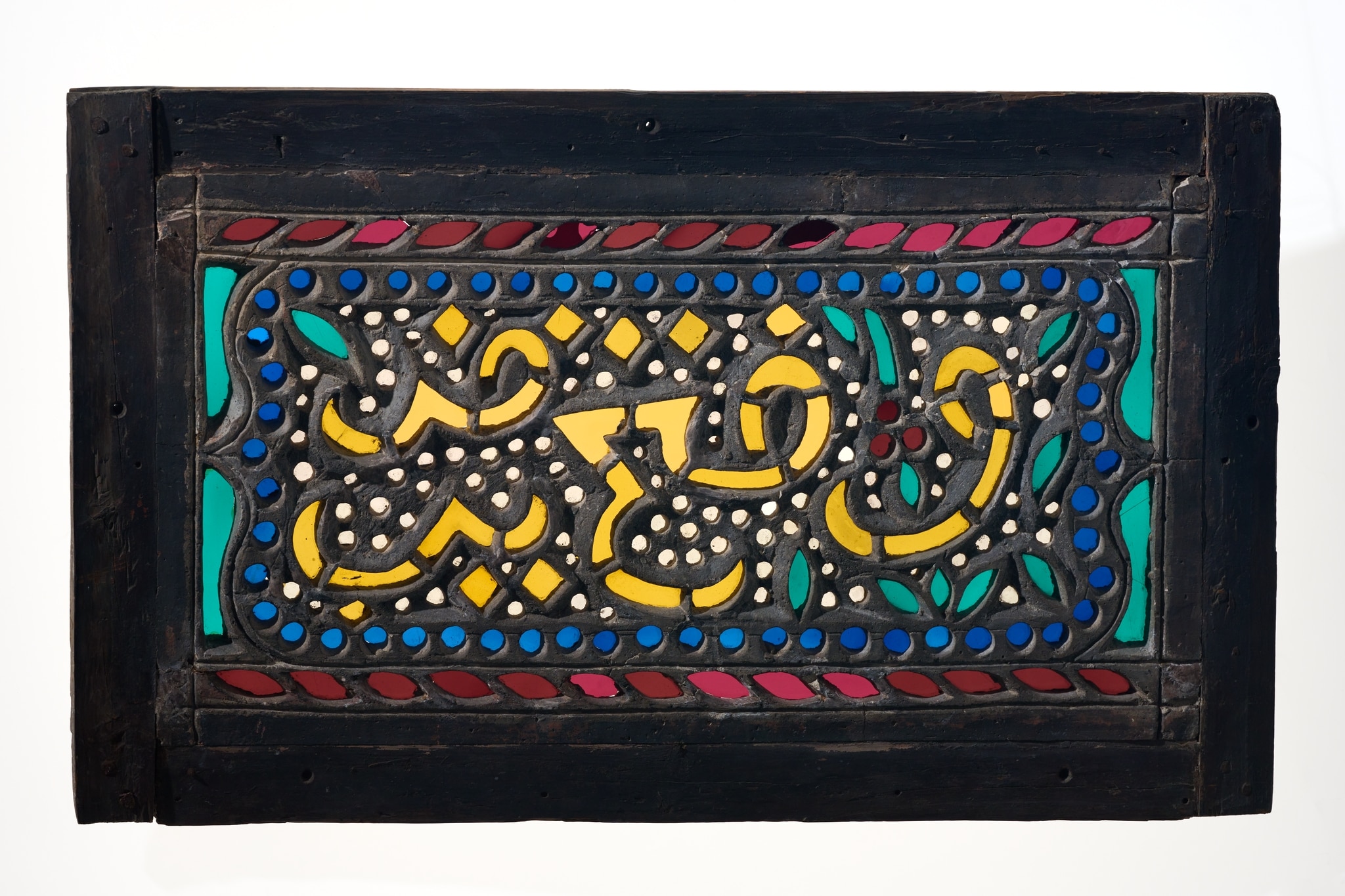
Latticework carved into a rectangular stucco panel and inlaid with pieces of colourless and coloured sheet glass.
The stucco panel was made by pouring plaster into a wooden frame. The plaster panel, which has a thickness of 15–18mm, is held in place by long nails, which were hammered into the frame from the outside when the stucco was not yet fully set. The pieces of glass are fixed on the back of the lattice with a thin layer of gypsum plaster. This layer is on average c.1mm thick.
The window is preserved in its original wooden frame, which measures 52 × 52mm. The thickness of the frame ranges from 20mm to 40mm. The frame consists of wooden slats joined together at the corners. Metal brackets attached to the back of the frame reinforce its structure.
The latticework is laid out on two levels: the main design (level 0) was carved out of the stucco panel using sharp, knife-like tools and following the lines of a preliminary drawing incised in the surface of the panel. Traces of the incisions are still visible in some places on the front. The second level (level –1), which lies 5–8mm below level 0, shows irregularly spaced, slightly conical perforations that are 10–12mm in diameter. The distance between the holes is 5–10mm. The holes were pierced with a metal or wooden pin in the stucco before it was fully set.
The main design and the perforations have been worked in such a way that the incident light is directed slightly downwards into the room.
The holes are backed with colourless glass. Turquoise, blue, yellow, and flashed (purple) red glass was used in the inscription, cartouche, and frame. Small, elongated bubbles as well as uneven surfaces indicate that the glass sheets were mouth-blown. In some places, we can observe bubbles that run in parallel, suggesting that the broad-sheet or cylinder-blowing technique was used to manufacture the flat glass.
The pieces of glass were cut according to the design of the latticework. Scratch marks along the edges of some of the pieces testify to the use of a glass-cutter. The colourless and the coloured glass have a thickness of c.1mm.
State of Preservations and Restorations
The stucco and glass window is preserved in its original wooden frame. The front of the latticework is mostly intact. There are some cracks and smaller losses, mostly along the edges of the panel. Some pieces of glass are missing. The wood of the frame is brittle and splintered in places, especially at the corners.
The back of the window shows traces of several repairs. The measures included replacing missing pieces of coloured glass (c.30%) with coloured plastic film and filling gaps in the thin stucco layer in which the pieces of glass are embedded with various filler materials. These differ in colour and texture from the original plaster layer, whose surface is dusty and therefore greyish brown in colour. Moreover, a filler material of unknown composition was applied along the edges of the panel, possibly to close larger gaps between the panel and the frame. At an unknown time, the frame was reinforced with metal brackets, which were attached to the corners at the back. The metal brackets and the nails holding the stucco panel in the frame are heavily rusted. The corrosion of the metal parts has led to fine cracks and small losses on the back of the stucco panel.
In the area of the corners, where the metal brackets are attached to the frame, there are traces of a rust-coloured substance, which extends onto the stucco panel in some places. Whether these are traces of rust or remnants of an adhesive could not be determined during the investigation. Interestingly, similar traces can be found in the area of the pieces of glass replaced with foil. It is likely that these are the yellowed remains of an adhesive that was used to fix the foil and to consolidate the repaired areas.
In 2021, a further restoration was carried out, during which loose stucco fragments were secured with Paraloid B-72 dissolved in acetone and loose pieces of glass were reattached.