Image Ordered

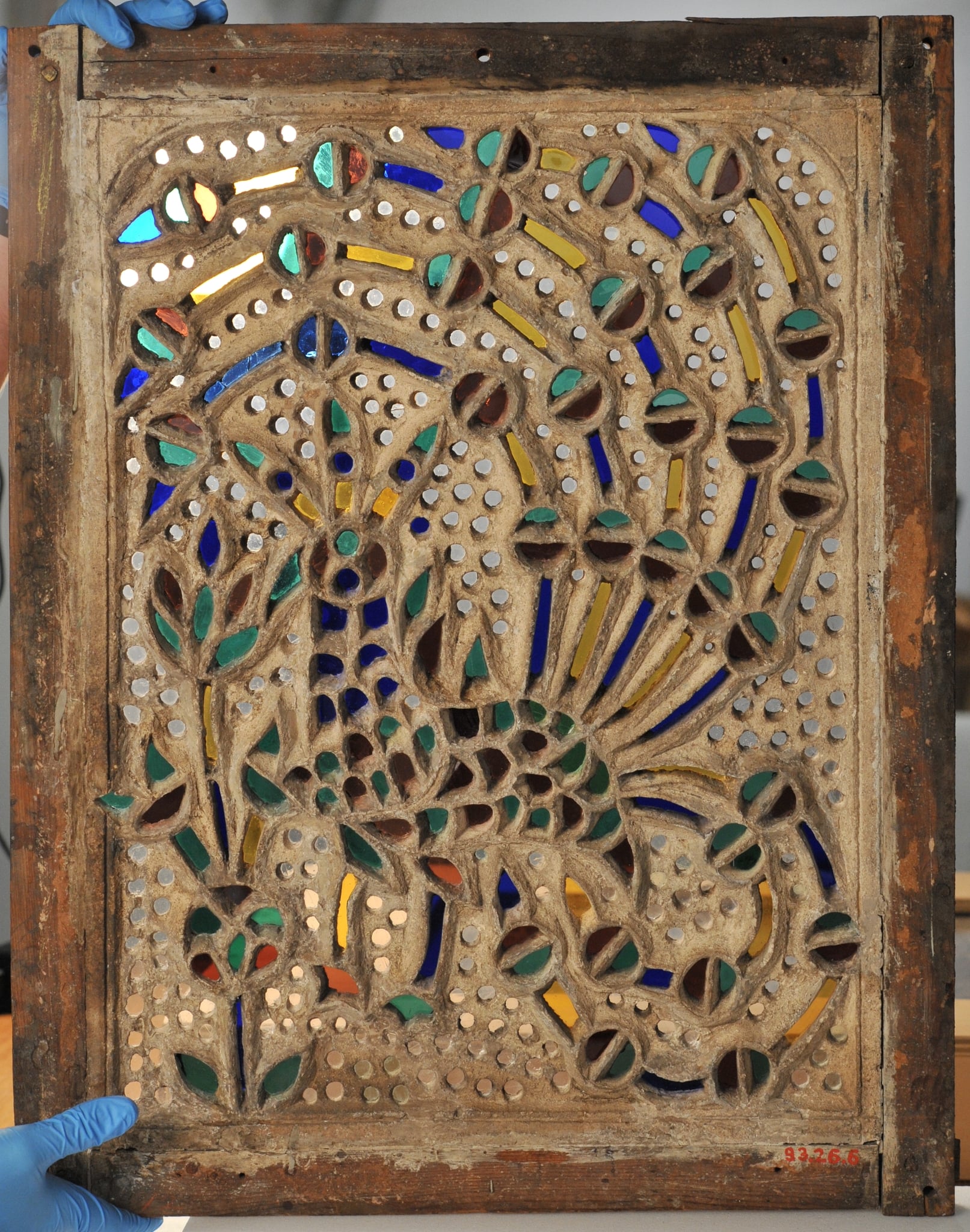
IG_183: Stucco glass window with a peacock
(USA_NewYork_MetropolitanMuseumOfArt_IG_183)

Contact Details

Please specify your first name.
Please specify your name.
Please specify your e-mail address.
The e-mail address is invalid.

Please provide as much information as possible (publication title, database, publisher, edition, year of publication, etc.).

The Vitrocentre Romont can only provide you with its own photographs. We regret that we cannot supply images from third parties to you. If your order concerns photographs from third parties, we will send you the contact address from which the images can be obtained.

The personal data you provide in this form will be used by Vitrocentre Romont exclusively for the processing of your image order. Correspondence regarding the order will be archived for internal reference. The data will not be used for purposes other than those listed here, nor will it be passed on to third parties. By sending the order form, you agree to this use of your personal data.

Should you have any questions, please send us an e-mail: info@vitrosearch.ch.

Title

Stucco glass window with a peacock

Type of Object
Dimensions
67 x 52.7 x 3.2 cm (with frame); 58.7 x 44.5 x 2.9 cm (without frame)
Artist / Producer
Place of Manufacture
Dating
early 13th–early 14th centuries AH / 19th century CE
Location
Inventory Number
93.26.6
Research Project
Author and Date of Entry
Francine Giese, Sophie Wolf 2025

Iconography

Description

The stucco and glass window shows a peacock turned towards the viewer’s left, the its tail feathers spread. A stem with different blossoms – a rose, two tulips, and a lily – grows to the left of the peacock. The bird’s plumage touches the frame in several places. The design is worked out in relief against a perforated background that lies approximately 10mm below the stucco surface.

Iconclass Code
25F35(PEACOCK) · ornamental birds: peacock
25G41(LILY) · flowers: lily
25G41(ROSE) · flowers: rose
25G41(TULIP) · flowers: tulip
Iconclass Keywords
lily · peacock · rose · tulip

Materials, Technique and State of Preservation

Materials

Coarse-grained gypsum plaster; colourless glass with a green tint; coloured glass (two shades of green, three shades of blue, two shades of yellow (including orange colour), two shades of red flashed glass); clear colourless glass (replacement)

Technique

The latticework was carved into a rectangular stucco panel and inlaid with colourless and coloured sheet glass. The pieces of glass are fixed onto the back of the lattice with a thin layer of gypsum plaster. The thickness of the stucco panel is 15–22mm. The stucco panel has been cast into wooden frame measuring c.40 × 40 × 30mm.

The design of the latticework has two levels. The main motif (level 0) has been carved out of the stucco panel with sharp, knife-like tools following a template incised in the surface of the panel. Traces of the incisions are still visible in some places on the front. The second level (level –1), which lies c.10mm below level 0, shows regularly spaced perforations. The holes were pierced with a metal or wooden pin in the stucco before it was fully set. They are c.10mm in diameter. The distance between the holes is 5–10mm. All holes are backed with colourless glass. The main design and the perforations have been worked in such a way that the incident light is directed downwards into the room.

Most pieces of glass have a smooth surface and no visible bubble inclusions. Only the colourless glass with a green tint shows elongated, parallel bubbles. The sheet glass from which these pieces were cut is mouth-blown, possibly produced using the broad-sheet method. The pieces of glass were cut using a glass-cutter. Some of the pieces of glass show scratch marks along the edges that testify to the cutting process. The thickness of the glass ranges between 1.5 and 3mm.

State of Preservations and Restorations

The stucco latticework shows a few fissures and minor losses, but is generally intact. There are signs of earlier restorations. These repairs involved filling losses in the latticework and refixing loose pieces of glass with an adhesive and supplementing the thin plaster layer in which the pieces of glass are embedded with various materials.

There are traces of various unidentified materials on all sides of the frame, which might relate to the restoration of the window.

History

Research

This stucco and glass window is one of the few examples conserved in Western museum collections representing a peacock. The bird’s colourful plumage and its association with royalty and paradise make it one of the most popular motifs of art across time and cultures (Dittrich, 2005, pp. 348–360; Riese, 2007, pp. 328–329). The peacock is also a recurring motif in Islamic art (Daneshvari, 1994; Viré/Bear, 2012).

The enthusiasm for the bird’s exotic beauty and colourful plumage reached a peak in the Western arts of the 19th and early 20th centuries, where the peacock became one of the main motifs of Art Nouveau stained glass (Michel, 1986, p. 84).

This interest in the peacock motif is also manifest when it comes to stucco and glass windows. This is attested by sketches and paintings of qamariyyāt representing a peacock by John Frederick Lewis (1805–1876) and James William Wild (1814–1892). As in the window discussed here, they show the peacock from the side (IG_118, IG_119, IG_122, IG_125, IG_447, IG_449). The peacock motif was also reinterpreted in stucco and glass windows designed in the late 19th and early 20th centuries in the Ottoman empire (IG_334) and in Europe (VMR_1387).

Although qamariyyāt depicting peacocks are rare today, the window discussed here finds a close counterpart in a specimen held at the MIT Libraries in Boston (IG_259). Both windows show the peacock in profile. The depiction of its head and tail, as well as the flower stem placed in front of the bird, show surprising similarities. However, due to differences in the way the design has been executed, the two windows were not necessarily made in the same workshop.

From a technical point of view, it can be assumed that the window discussed here was made in Egypt during the Late Ottoman period. According to the museum records, it dates to the 18th century. We assume however that the window was made at a later date, possibly around the time it was acquired by Robert Ware (see below). One reason for this hypothesis is the good state of preservation of the stucco lattice, which would have shown clearer signs of weathering if it had been installed and exposed to the elements for a longer period before purchase. Another reason for a later dating is the use of cylinder-blown flat glass (also called broad-sheet). In the Islamic world, sheet glass was usually produced using the crown-glass process, while in Europe, the broad sheet-method was the dominant technique to manufacture flat glass. The Hungarian architect Max Herz (1856–1819) states that sheet glass was imported to Egypt from Europe from the 19th century, because local production had come to a standstill (Herz, 1902, p. 53).

A hand-written letter dated 22 May 1893 to Luigi Palma di Cesnola (1832–1904), the then director of The Metropolitan Museum of Art in New York provides information on the provenance of the window. The author of this letter, the American architect William Robert Ware (1832–1915), writes that he had acquired this and various other windows in the spring of 1890 from several well-known art and antiquity dealers in Cairo. He mentions [Gaspare] Giuliana, [E. M.] Malluk, [Nicolas?] Tano, and [Panayotis] Kyticas (on their commercial activities see Volait, 2021, pp. 60–64). In his letter, Ware further states that he was told that the windows ‘had been taken from old houses’ and ‘from old mosques, that had been dismantled’, but that he was not able to get ‘any precise information as to their original places’ (Ware, 1893).

In 1893, Ware donated this window as part of a lot of 17 qamariyyāt (IG_169, IG_171–186) to The Metropolitan Museum of Art (Ware, 1893).

Dating
early 13th–early 14th centuries AH / 19th century CE
Period
1800 – 1899
Previous Locations
Place of Manufacture

Provenance

Owner
Since 1893: The Metropolitan Museum of Art, Inventory Number: 93.26.6, collection (access date: 6.12.2024), New York (United States of America), Donation
Previous Owner
From 1890 until 1893: Ware, William Robert

Bibliography and Sources

Literature

Brigitte Riese, Seemanns Lexikon der Ikonografie. Religiöse und profane Bildmotive, Leipzig 2007.

Daneshvari, A. (1994). A preliminary study of the iconography of the peacock in Medieval Islam. In: R. Hillenbrand (ed.), The Art of the Saljūqs in Iran and Anatolia (pp. 192–200). Costa Mesa: Mazda Publishers.

Herz, M. (1902). Le musée national du Caire. Gazette des Beaux-Arts, 3. Pér. 28, 45–59, 497–505.

Sigrid und Lothar Dittrich, Lexikon der Tiersymbole. Tiere als Sinnbilder in der Malerei des 14.–17. Jahrhunderts, 2nd edition, Petersberg 2005.

Viré, F., & Bear, E. (2012). Tāwūs. In: P. Bearman et al. (eds.), Encyclopaedia of Islam. Second Edition, Leiden 2012, http://dx.doi.org/10.1163/1573-3912_islam_COM_1204.

Volait, M. (2021). Antique Dealing and Creative Reuse in Cairo and Damascus 1850–1890. Leiden: Brill.

Ware, W. R. (1893, May 22). [Letter to Luigi Palma di Cesnola]. MET Archives (W 229), New York City, NY, United States.

Image Information

Name of Image
USA_NewYork_MetropolitanMuseumOfArt_IG_183
Credits
Vitrocentre Romont
Date
2023
Copyright
Public Domain

Citation suggestion

Giese, F., & Wolf, S. (2025). Stucco glass window with a peacock. In Vitrosearch. Retrieved December 5, 2025 from https://www.vitrosearch.ch/objects/2713027.

Record Information

Reference Number
IG_183