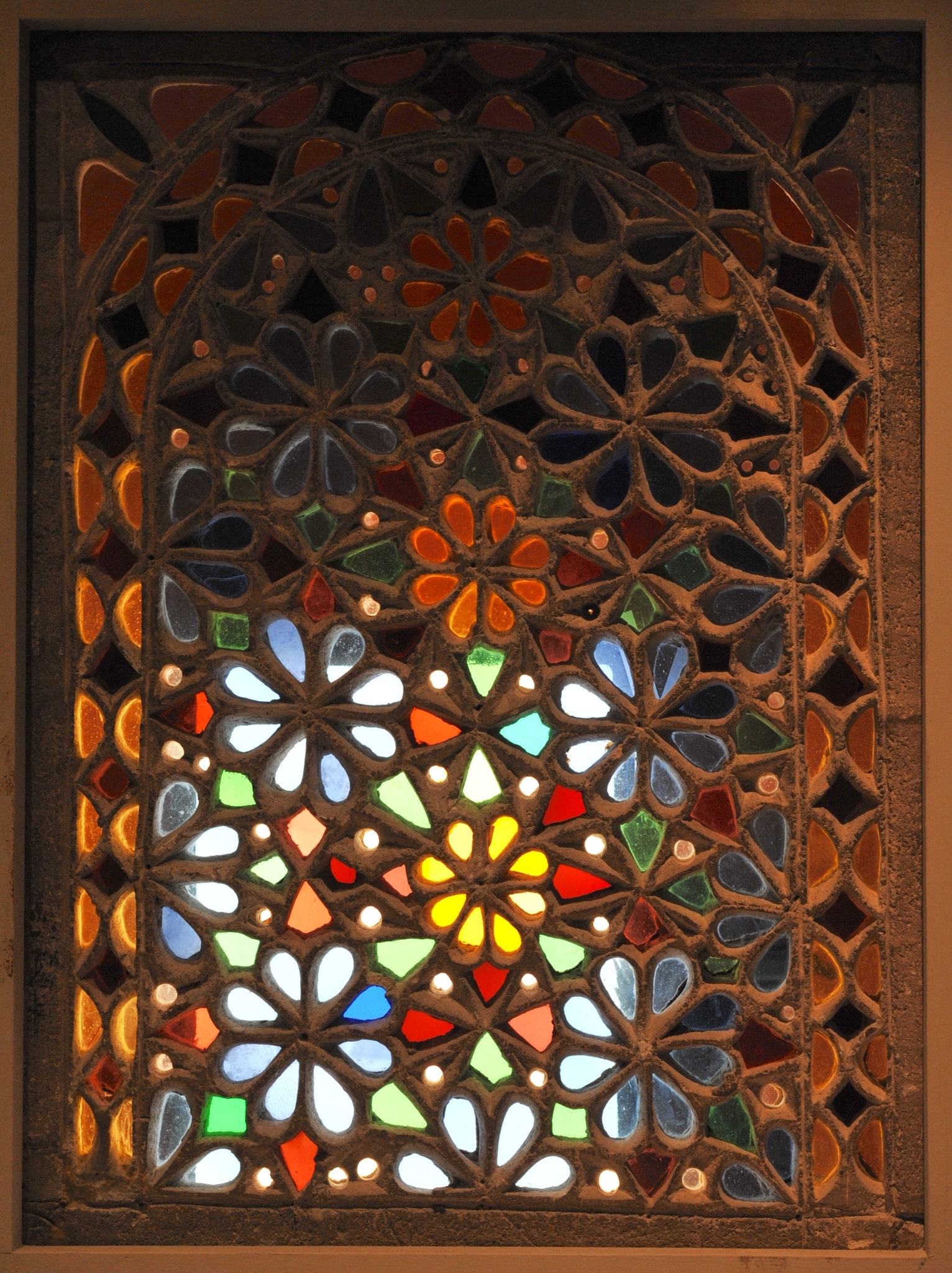
This stucco and glass window corresponds iconographically and technically to one of the standard types of qamariyya widespread in Egypt during the Ottoman period. Windows of this type aroused the interest of the British architect James William Wild (1814–1892), who produced schematic drawings of several of examples during his stay in Cairo in the years 1844–1847 (IG_436, IG_440, IG_448).
Symmetrically arranged flowers and stars are a recurring element of Islamic ornamentation across time and media. However, the insertion of a flower within a star is uncommon in the western Islamic world (al-Andalus and Maghreb), where star ornamentation is always restricted to purely geometric forms (IG_170, IG_363, IG_364, IG_366).
Several windows within the collection of the Musée du Louvre in Paris, which most likely were made in Cairo, show similar ornamentation (see for instance IG_12, IG_38, IG_40). The window discussed here, however, has a more sophisticated design than the Louvre ones, with the central field being composed of three parallel rows of flowers and stars being framed by a semicircular arch. One may therefore assume that the window from the MET, unlike the Louvre specimens, which were part of composite windows, was probably an independent qamariyya.
According to the museum records, the window dates to the 17th century. However, there are some indications that point to a later production date. Firstly, the good state of preservation of the stucco lattice, which would have shown clearer signs of weathering if it had been installed and exposed to the elements for a longer period of time, and secondly, the use of cylinder-blown flat glass (also called broad-sheet). In the Islamic world, sheet glass was usually produced using the crown-glass process, while in Europe, the broad sheet-method was the dominant technique to manufacture flat glass. The Hungarian architect Max Herz (1856–1819) states that sheet glass was imported to Egypt from Europe from the 19th century, because local production had come to a standstill (Herz, 1902, p. 53).
A hand-written letter dated 22 May 1893 to Luigi Palma di Cesnola (1832–1904), the then director of The Metropolitan Museum of Art in New York provides information on the provenance of the window. The author of this letter, the American architect William Robert Ware (1832–1915), writes that he had acquired this and various other windows in the spring of 1890 from several well-known art and antiquity dealers in Cairo. He mentions [Gaspare] Giuliana, [E. M.] Malluk, [Nicolas?] Tano, and [Panayotis] Kyticas (on their commercial activities see Volait, 2021, pp. 60–64). In his letter, Ware further states that he was told that the windows ‘had been taken from old houses’ and ‘from old mosques, that had been dismantled’, but that he was not able to get ‘any precise information as to their original places’ (Ware, 1893).
In 1893, Ware donated this window as part of a lot of 17 qamariyyāt (IG_169, IG_171–186) to The Metropolitan Museum of Art (Ware, 1893).
Mentioned in: Carboni, 2003, p. 76.
Illustrated in: Jenkins, 1986, back cover.