Image Ordered

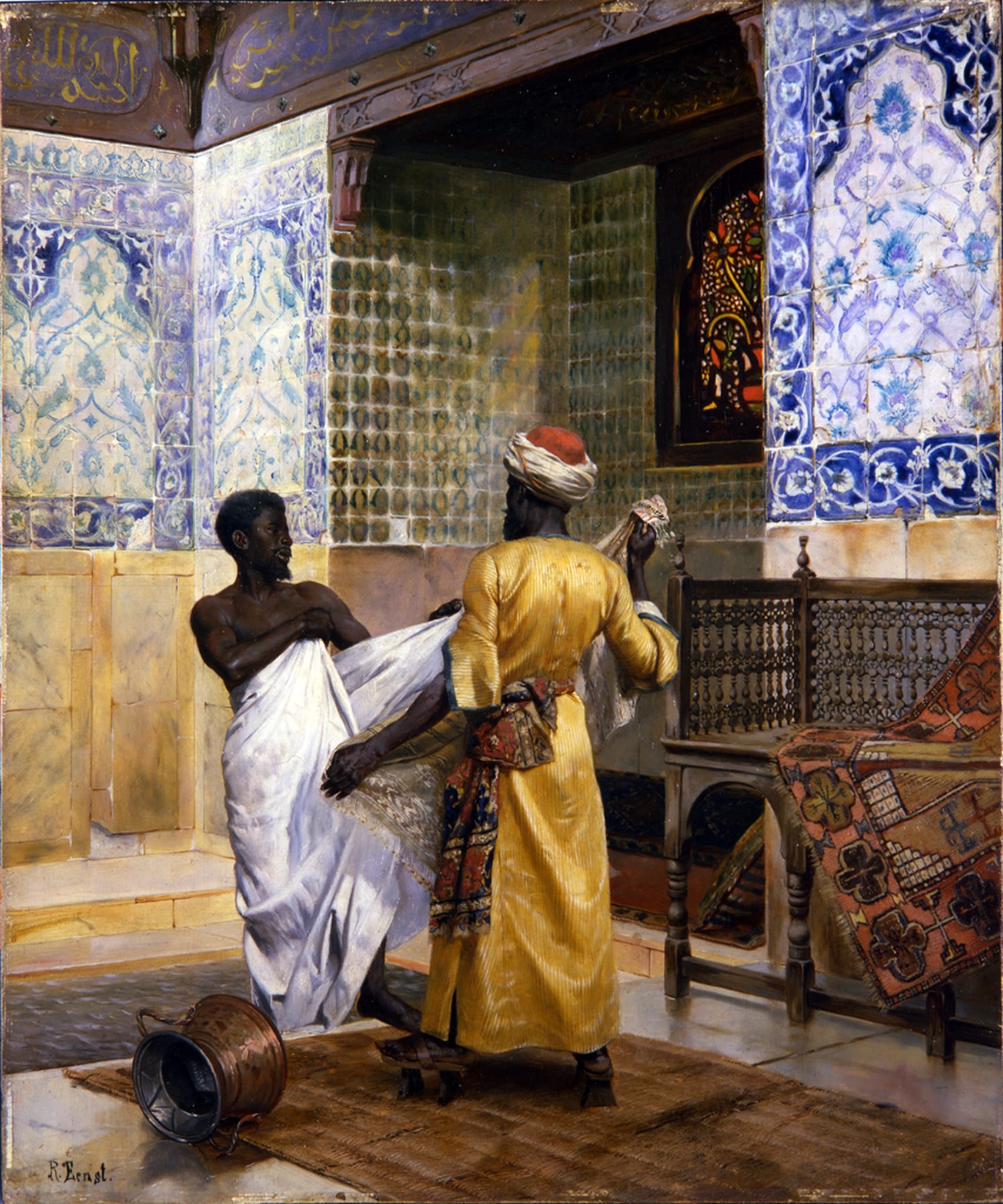
IG_141: A Moor Robing After the Bath
(USA_Milwaukee_HaggertyMuseumOfArt_IG_141)

Contact Details

Please specify your first name.
Please specify your name.
Please specify your e-mail address.
The e-mail address is invalid.

Please provide as much information as possible (publication title, database, publisher, edition, year of publication, etc.).

The Vitrocentre Romont can only provide you with its own photographs. We regret that we cannot supply images from third parties to you. If your order concerns photographs from third parties, we will send you the contact address from which the images can be obtained.

The personal data you provide in this form will be used by Vitrocentre Romont exclusively for the processing of your image order. Correspondence regarding the order will be archived for internal reference. The data will not be used for purposes other than those listed here, nor will it be passed on to third parties. By sending the order form, you agree to this use of your personal data.

Should you have any questions, please send us an e-mail: info@vitrosearch.ch.

Title

A Moor Robing After the Bath

Type of Object
Dimensions
53.02 x 44.45 cm
Artist / Producer
Dating
c. 1900
Research Project
Author and Date of Entry
Sarah Tabbal 2024

Iconography

Description

The painting A Moor Robing after the Bath by the Vienna-born Orientalist painter Rudolf Ernst (1854–1932) represents two men in a bath. One man, depicted from the rear and wearing a golden-yellow garment and a white and red turban, and a second man stepping out of a water basin (Carter, 2006, pp. 26–27). In a niche on the right side of the painting, a stucco and glass window with the motif of symmetrically arranged flowers in a red and green vase is partly visible.

Iconclass Code
41A33 · window
41A6711 · flowers in a vase
Iconclass Keywords

Materials, Technique and State of Preservation

Technique

Oil on panel.

History

Research

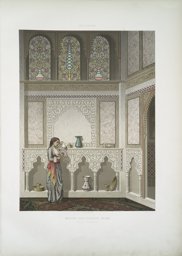
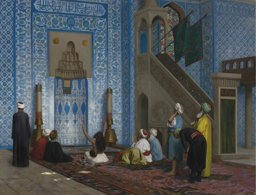
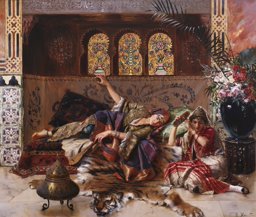
Ernst also depicted windows of this type, with stylized flowers symmetrically disposed in a green and red vase, in other Orientalist paintings: in Au harem (IG_153), three coloured stucco and glass windows are depicted in a recess, two of which show the motif of stylized vases of flowers. Another example is Ernst’s painting Tending the Lamp (oil on panel, 61 × 48cm, Sotheby’s (2018): The Orientalist Sale (Sale L18100), 24 April 2018, London, lot 14), where two windows with the motif of stylized flowers in a green and red vase are represented on the left side of the painting. Two stucco and glass windows with the motif of symmetrically arranged flowers in a red and green vase can be seen in a chromolithograph by Émile Prisse d’Avennes (IG_31) that, according to the caption, represents the upper room of the Cairene house of ‘Sidi Youçouf Adami’. The impact of Prisse d’Avennes’s chromolithograph cannot only be seen in works by Rudolf Ernst, but also in the painting Rüstem Pasha Mosque Istanbul by Jean-Léon Gérôme (IG_149).

Dating
c. 1900
Period
1885 – 1932

Provenance

Donor / Vendor

Gift of the Estate of Claire Hoff Toole

Bibliography and Sources

Literature

Carter, C. (2006). Rudolph Ernst, A Moor Robing after the Bath. In Perspectives on Art at the Haggerty Museum. Milwaukee, WI: Haggerty Museum of Art.

Image Information

Name of Image
USA_Milwaukee_HaggertyMuseumOfArt_IG_141
Credits
© Marquette University

Linked Objects and Images

Linked Objects
Cairo, Maison Sidi Youçouf Adami: salon supérieur
Rüstem Pasha Mosque Istanbul
Au harem

Citation suggestion

Tabbal, S. (2024). A Moor Robing After the Bath. In Vitrosearch. Retrieved December 5, 2025 from https://www.vitrosearch.ch/objects/2712985.

Record Information

Reference Number
IG_141