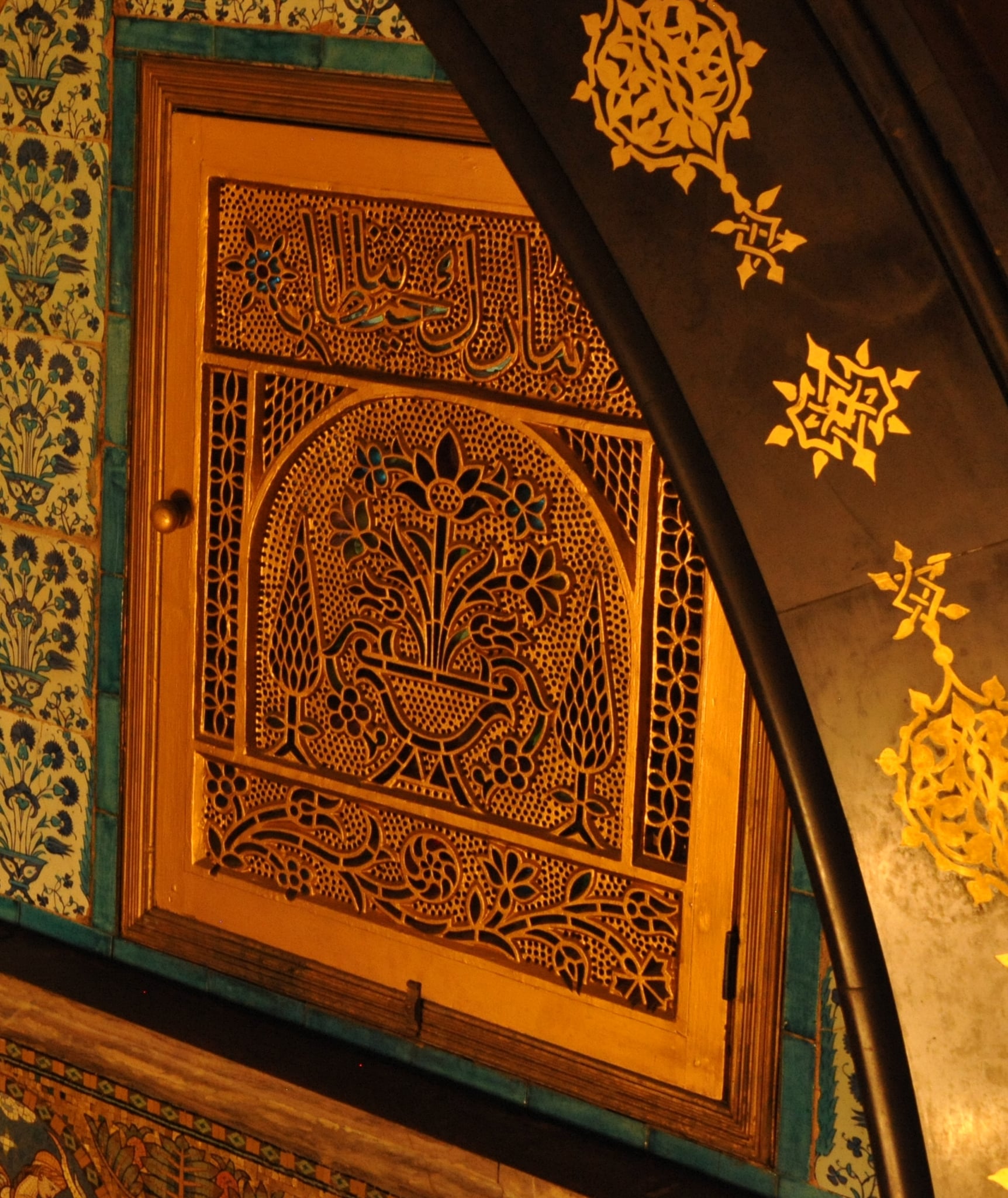
This replica of a stucco and glass window is composed of three panels. The main panel (2) is reminiscent of one of the most popular motifs of Islamic stucco and glass windows during the Ottoman period: flowers in a vase. The motif is widespread in Islamic decorative arts and can be found in numerous other media, such as ceramics, wood panelling, wall paintings, and textiles, over a long period of time, and in both sacred and profane contexts. A flower tendril (1) and an Arabic inscription (3) are placed below and above the main field, respectively. Stylistically, all three panels show clear differences from traditional qamarīyāt. It is therefore very likely that they were designed by a Western artist or architect.
The Arabic inscription tabāraka ḥīṭānunā (‘The tabāruk [the twenty-ninth part of the Quʿran] is our walls’) is taken from the Ḥizb al-baḥr of al-Shādhilī, from a section of the litany that mystically transforms different parts of the Quʿran into the features of a house (walls, door, roof, etc). Though common by virtue of the order’s wide dissemination in North Africa, Egypt, and Syria, this mystical transformation of the Quʿran’s constituent parts also attracted criticism. The Damascene polymath Ibn Taymiyya (d. 728 AH / 1328 AD) thus penned a refutation of the two litanies and other works by al-Shādhilī. Regarding this symbolic transformation, he comments, ‘[t]his prayer is not reported [from the Prophet], nor does it resemble the kind of prayer that is [typically] reported [from him]; it is the [kind] that hearts [naturally] reject. Making the words of God into a ‘door’, ‘roof’ or ‘wall’ and such things requires reports [to authorize them], otherwise they are innovations (ar. bidaʿ); such [litanies] might be understood as detracting from its [the Quʿran’s] sacredness.’ (Ibn Taymiyya, 1437 AH / 2016 CE). By virtue of being inscribed on the features of a house, the invocation refers not only to literal walls, but to the Quʿran.
Whereas panels with inscriptions are rarely represented in museum collections (IG_174, IG_292, IG_493–496) and isolated flower tendrils (without cypress trees) are almost non-existant, stucco and glass windows with flowers in a vase can be found in several of the collections studied (see for instance IG_7, IG_166, IG_176, IG_255, IG_261, IG_356). They also aroused the interest of Western artists and architects, as is attested by a significant number of book illustrations, sketches, and paintings (see for instance IG_43, IG_149, IG_153, IG_437, IG_443, IG_461). As of the 1850s, replicas with this motif were installed in Arab-style interiors across Europe (IG_64, IG_431, IG_484–487).
One of these interiors is the Arab Hall of the studio-house of the British artist and collector Frederic Leighton (1830–1896) at 12 Holland Park Road in Kensington (London), where the replica discussed here is located. Leighton House was constructed between 1865 and 1895 in five phases after plans by one of Leighton’s close friends, the British architect George Aitchison (1825–1910). Work on the Arab Hall extension began in 1877 and continued until 1881. At the Royal Institute of British Architects (RIBA), various drawings by Aitchison of the Arab Hall are conserved (IG_50–53). Two presentation drawings (IG_52, IG_53) showing the elevation of the east and west walls of the Arab Hall were exhibited at the Royal Academy in 1880. According to an anonymous report on Leighton House and the Arab Hall, published on 1 October 1880 in The Building News, the exhibited drawings by Aitchison showed ‘the decorations as completed’ (Anon., 1880, p. 384). We may therefore assume that the windows had already been installed in the Arab Hall in 1880.
Leighton House is one of the most famous 19th-century artist’s homes, combining living, working, and exhibition spaces, designed according to Leighton’s needs and aesthetic visions (Sweetman, 1988, pp. 189–192; Robbins/Suleman, 2005; Robbins, 2011; Anderson, 2011; Droth, 2011; Vanoli, 2012; Roberts, 2018; Gibson, 2020; Robbins, 2023). Leighton’s studio-house reflects the exotic taste of the time (Walkley, 1994, pp. 52–56), which finds close parallels in the now-lost studio of the British painter Frank Dillon (1832–1908). Dillon, who visited Cairo on several occasions in the 1850s – 1870s, recreated a Cairene interior with wall tiles, wooden furnishings, and two stucco and glass windows in his studio in Kensington (Conway, 1882, p. 196; Walkley, 1994, pp. 70), as attested by a wood engraving published in the second volume of Georg Ebers’s Aegypten in Bild und Wort (Ebers, 1880, p. 96, see IG_117).
The Arab Hall extension at Leighton House reflects the patron’s and the architect’s fascination for the East. As many orientalizing interiors, it is an amalgam of various Islamic styles, arranged around the central theme of the 12th-century Zisa Palace in Palermo. While Leighton was familiar with Islamic art and architecture through his travels to Sicily, Algeria, Turkey, Egypt, Syria, Spain, and Morocco, Aitchison was acquainted with Cairo, among other Islamic cities, where he examined traditional houses. He shared his observations during the discussion following the paper on ‘Persian Architecture and Construction’ given by Caspar Purdon Clarke (1846–1911) and Thomas Hayter Lewis (1818–1898) at the Royal Institute of British Architects on 31 January 1881. On this occasion, Aitchison described the iconographic and technical characteristics of Egyptian qamarīyāt and their sparkling light effects and added that ‘many [were] executed for me in London’ (Purdon Clarke & Hayter Lewis, 1881, pp. 173–174) – most probably referring to the Leighton House replicas that were being made at the time. More than 20 years later, in 1904, Aitchison returned to the subject of stucco and glass windows in his essay ‘Coloured Glass’, where he compared Western stained glass with qamarīyāt and mentioned Leighton House with its ‘windows of pierced plaster’ as an example illustrating the Islamic tradition (Aitchison, 1904, p. 57, see IG_91).
The British architect William Burges (1827–1881), who was a long-time friend of Aitchison and Leighton, must have been aware of these replicas when he planned the slightly later windows of the Arab Room at Cardiff Castle in Wales (IG_484–IG_487). However, Burges opted to execute the replicas at Cardiff Castle in glass, lead, and wood, whereas Aitchison stuck more closely to the Islamic prototypes – at least as far as the material was concerned. According to contemporary sources, Leighton acquired various stucco and glass windows during his travels to Cairo (1868) and Damascus (1873) (see for instance Anon., 1880; Wright, 1896; Rhys, 1900). Unfortunately, the Egyptian windows were damaged during shipping (Rhys, 1900, p. 100), something that apparently happened on other occasions (see for instance IG_43). The glass fell off the stucco lattice, and only part of it could be reused in the replica installed in the west wall of the Arab Hall (IG_56). All other windows had to be filled with ‘English imitations’ (Rhys, 1900, p. 100). The Reverend William Wright (1837–1899), who procured qamarīyāt ‘from a mosque in Damascus’ (Wright, 1896, p. 184) for Leighton during the latter’s visit to the city, adds that the Syrian stucco and glass windows ‘have also been supplemented and matched by coloured glass made in London’ (Wright, 1896, p. 184).