Beschreibung
Rectangular stucco and glass window consisting of two tapered cartouches arranged one above the other, the whole framed by squares.
Iconclass Code
Iconclass Stichworte

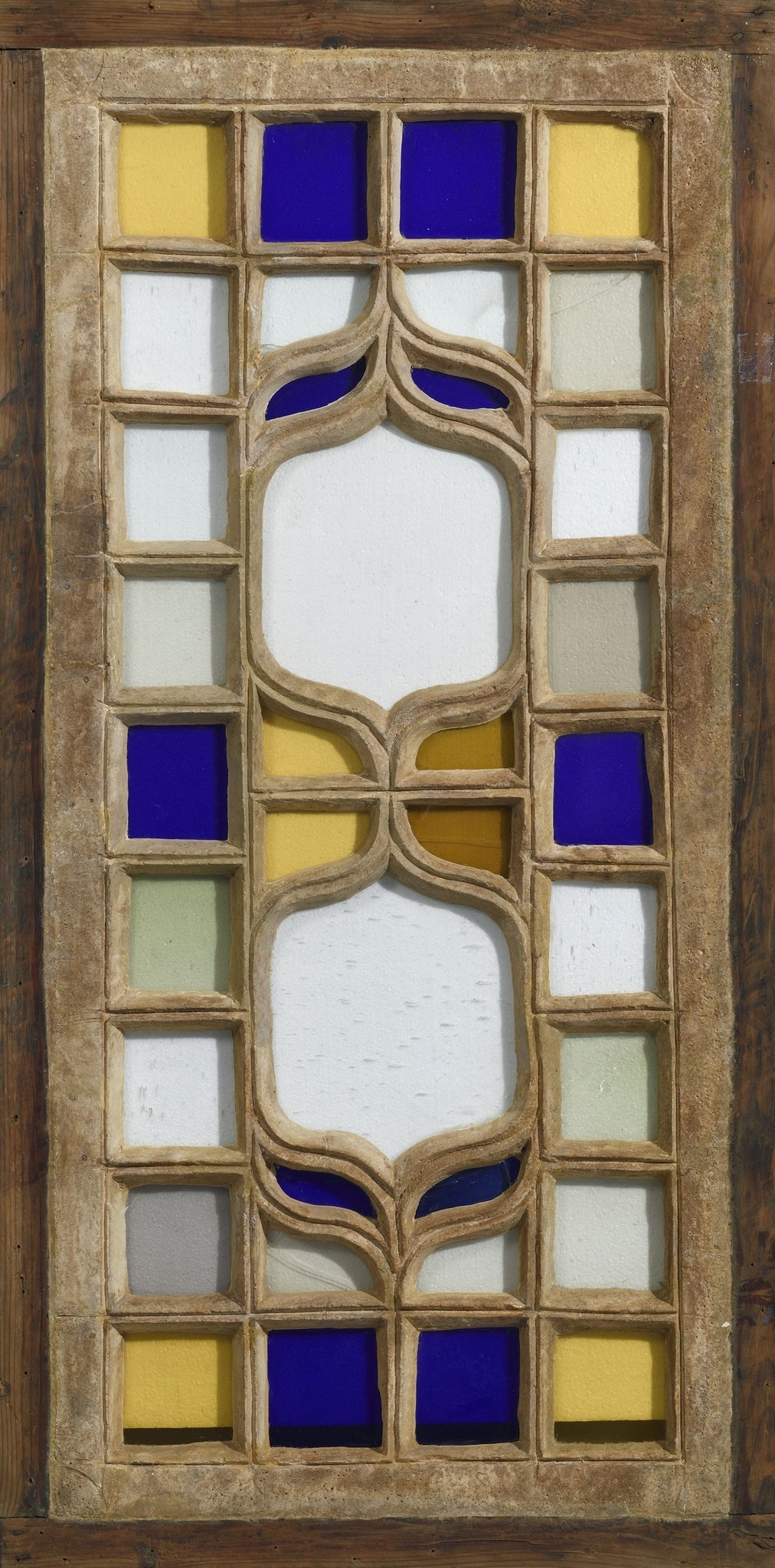
Rectangular stucco and glass window consisting of two tapered cartouches arranged one above the other, the whole framed by squares.
Gypsum plaster; colourless glass (including completely transparent as well as clear glass with a greyish or greenish tint); coloured glass (two shades of dark blue and two of yellow)
Latticework backed with colourless and coloured sheet glass. The delicate latticework was most likely produced by cutting the design out of a solid plaster panel following a template incised into plaster when it had not yet completely set. Traces of this process can still be observed, for example, in the corners of the panel. Some of the incisions, especially those set in the middle of the delicate stucco bars, seem to have a purely decorative function.
The pieces of glass are mounted on the back of the stucco lattice and fixed with a thin layer of plaster. This layer is 0.5–1.5mm thick. The average thickness of the stucco panel is 22–25mm. The panel is preserved in its original wooden frame, into which the plaster panel has been set. The frame has a thickness of 40–45mm.
The glass is either colourless or coloured in the mass. Elongated parallel bubbles indicate that the glass sheets were mouth-blown. The forms were cut according to the design of the latticework using a glass cutter. The cutting process left scratch marks along the edges of some of the pieces.
The window was badly damaged and was thoroughly restored in 2003. At the time of restoration, only around 70% of the latticework and 10% of the original pieces of glass were preserved. The missing 90% of the pieces of glass were replaced with new glass, which was attached with cellulose nitrate. Larger defects in the latticework, i.e., all the missing elements, were filled with cast plaster copies. The restoration measures also included cleaning the surface of the stucco lattice (laser cleaning, density: 1.5 J/cm2 at 1064nm, strengthening the latticework with carbon fibre, and consolidating fragile areas with gauze and acrylic resin. Fissures and lacunae in the stucco lattice were repaired with acrylic fillers. The repairs were retouched with pigmented acrylic emulsion. The original wooden frame was cleaned with solvent and reinforced by adding an aluminium frame.
This window stands out from the other qamariyyāt studied as part of the project. It is a rare example held in Western museum collections that demonstrates the cultural and artistic impact of the Ottoman capital on the provinces. From a formal and stylistic point of view, it corresponds to a type of window introduced in Istanbul in the late 16th century (Bakırer, 2001, 8–15. See for instance IG_369, IG_385, IG_386). The delicate structure of the latticework and the use of large, colourless pieces of glass reflect the ongoing process of Westernisation which culminated during the so-called Ottoman Baroque period (see for instance Rüstem, 2019). The manufacturing technique of the here studied window however remains within the Egyptian tradition. In Egyptian qamariyyāt the stucco lattice is cut out of a solid stucco panel, whereas in the windows from Turkey the lattice is cast (see Arseven, 1939, pp. 207–211; Arseven, [c.1952], pp. 182–189; Özakın, 2007, pp. 95–97).
According to the museum records, the window dates to the 16th or 17th century. However, considering the formal similarity to the window type described above, which was only introduced in Istanbul in the 18th century, this window can hardly have been made before that date. Its poor state of preservation, recorded before the 2003 restoration, is primarily due to the fragility of the narrow stucco mouldings, as can also be observed in other windows of the same type, see in particular IG_369.
The Cairo-based, Cypriot art and antique dealer Phokion Tanos (1898–1972) donated this window – along with 12 other qamariyyāt (11049–11059, 20969, 20960, see IG_336–359) – to the Benaki Museum in Athens, probably in the 1940s.
Arseven, C. E. (1939). L’art turc depuis son origine jusqu’à nos jours. Istanbul.
Arseven, C. E. [c. 1952]. Les arts decoratifs turcs. Istanbul.
Bakırer, Ö. (2001): Window Glass in Ottoman Vernacular Architecture. EJOS, 4/9, 1–29.
Özakın, R. (2007). Traditional Turkish Gypsum Plaster Windows. Manufacture and Conservation. In: L. Pilosi (ed.). Glass and ceramics conservation 2007. Interim meeting of the ICOM-CC Working Group. Nova Gorica.
Rüstem, Ü. (2019). Ottoman Baroque. The Architectural Refashioning of Eighteenth-Century Istanbul. Princeton.