Forschung
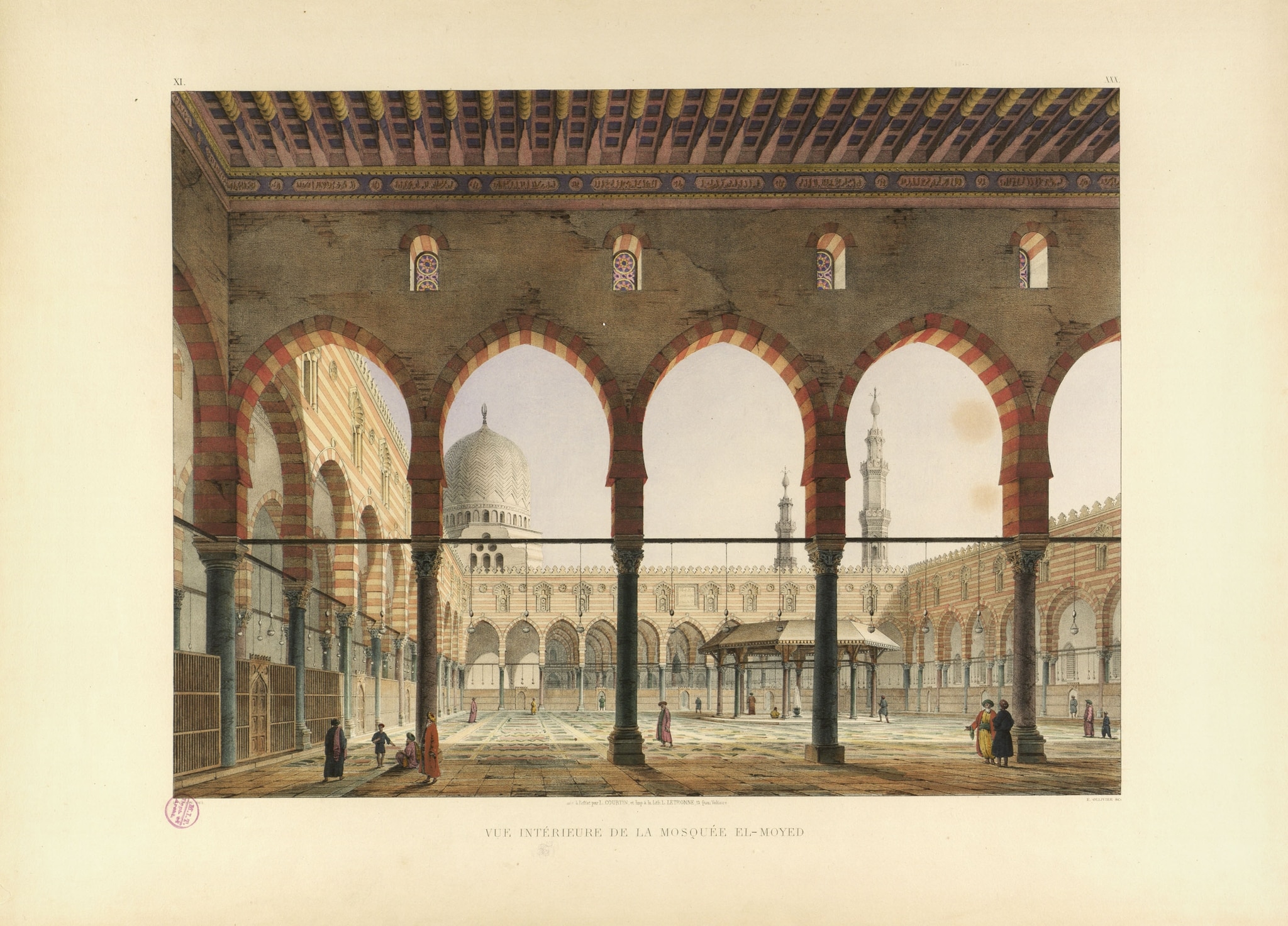
Pascal Coste’s plates are based on the extensive documentation he made in Cairo between 1818 and 1827. The Sultan al-Muʾayyad Shaykh Mosque (818–24 AH / 1415–21 CE) was the first one to be documented by the French architect, and more than 30 drawings, made in 1822, of the complex are preserved (Volait, 1998, p. [3]). One drawing shows the stucco and glass windows of the qibla wall (IG_223) and one shows a detail of the here depicted windows of the courtyard (Marseille, Bibliothèque de l’Alcazar, MS1310_f12b).
While some of the 70 plates of Coste’s book were published as line drawings or shaded versions, the view of the courtyard of the Sultan al-Muʾayyad Shaykh Mosque was coloured. Although the main focus of the illustration is not on the windows, their design is detailed and seems to correspond to reality. A few decades later, around 1872, large parts of the mosque were in ruins, and at the end of the 19th century it was renovated by the Comité de Conservation des Monuments de l’Art Arabe. The stucco and glass windows installed today above the arcades of the prayer hall show the same design as in Coste’s plate. While some windows may have survived until today, some were certainly copied in the same style by the Comité (Barois/Grand/Sedak/Herz, 1890, p. 74). While in Coste’s time all the walls facing the courtyard had window openings, as seen on the plate, today, only the inner arcades of the prayer hall have windows.
While the star motif is not uncommon and often appears as a single motif (see the windows in the dome of the Sultan al-Muʾayyad Shaykh Mosque; IG_186; Victoria and Albert Museum, MES.LOST.30), other windows with two star motifs, one surmounting the other, are not known.
Datierung
1837
Zeitraum
1818 – 1837
Verknüpfte Standorte