
Bestelltes Bild

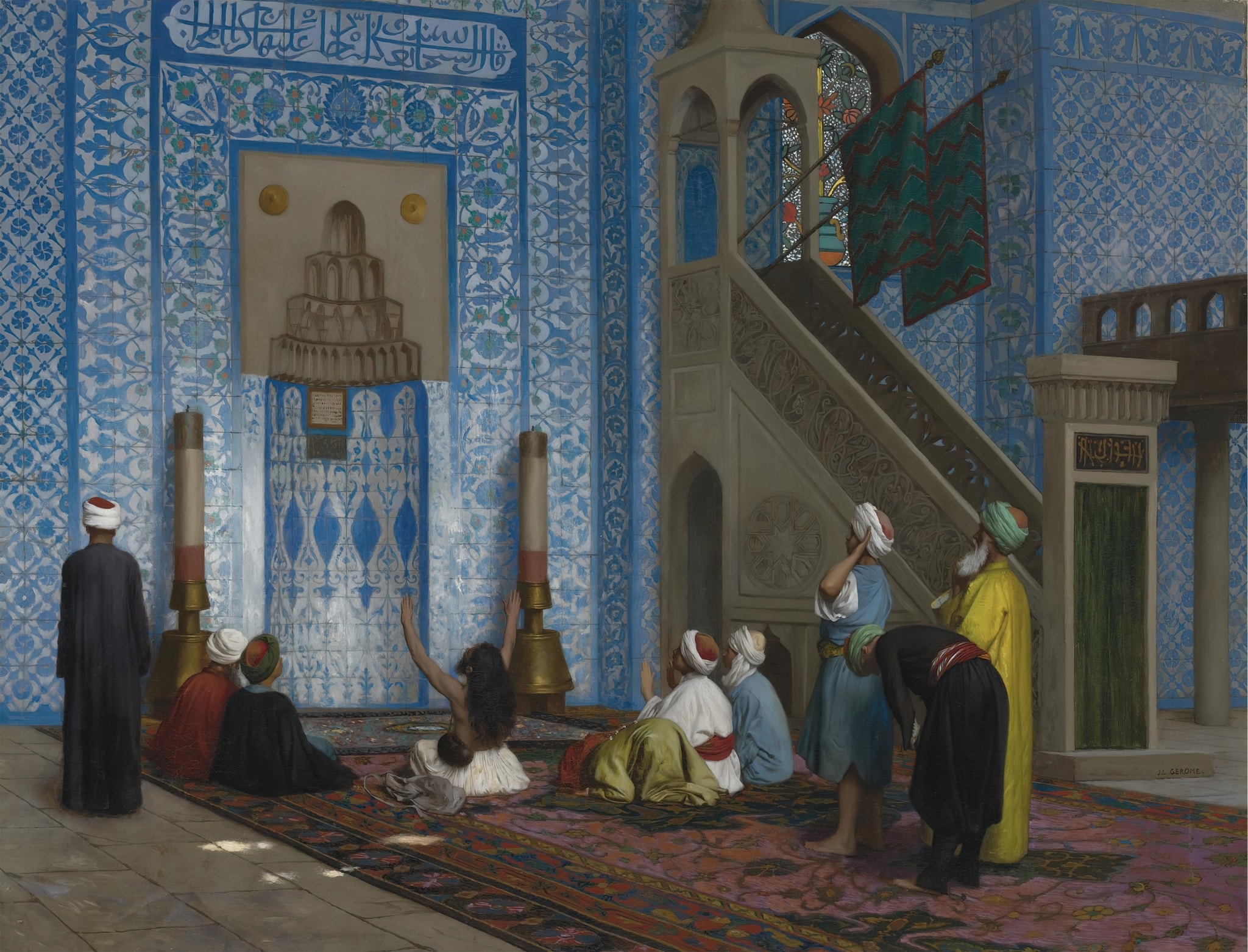
IG_149: Rüstem Pasha Mosque Istanbul
(MISC_IG_Gerome_IG_149)

Kontaktdaten

Bitte geben Sie Ihren Vornamen ein.
Bitte geben Sie Ihren Namen ein.
Bitte geben Sie Ihre E-Mail-Adresse ein.
Die E-Mail-Adresse ist ungültig.

Bitte machen Sie so viele Angaben wie möglich (Titel der Publikation, Datenbank, Herausgeber, Auflage, Erscheinungsjahr, usw.)

Das Vitrocentre Romont kann Ihnen nur eigene Bilder zur Verfügung stellen. Bilder von Dritten können wir Ihnen leider nicht überlassen. Betrifft Ihre Bestellung Fotografien von Drittparteien, senden wir Ihnen die Kontaktadresse, über welche die Bilder bezogen werden können.

Die von Ihnen in diesem Formular angegebenen Personendaten werden vom Vitrocentre Romont ausschliesslich für die Bearbeitung Ihrer Bildbestellung verwendet. Die Korrespondenz zur Bestellung wird zur internen Nachvollziehbarkeit archiviert. Die Daten werden weder für andere als die hier aufgelisteten Zwecke verwendet noch an Dritte weitergegeben. Durch das Absenden des Bestellformulars erklären Sie sich mit dieser Nutzung Ihrer Personendaten einverstanden.

Bei Fragen können Sie gerne eine E-Mail an info@vitrosearch.ch senden.

Titel

Rüstem Pasha Mosque Istanbul

Art des Objekts
Masse
67.6 x 88.5 cm
Künstler:in / Hersteller:in
Datierung
c. 1880
Standort
Forschungsprojekt
Autor:in und Datum des Eintrags
Sarah Tabbal 2024; Sarah Keller 2025

Ikonografie

Beschreibung

The painting Rüstem Pasha Mosque Istanbul by Jean-Léon Gérôme (1824–1904) depicts a group of men in a mosque, gathered in a semicircle in front of the mihrab and shown in various states of prayer. The richly decorated interior demonstrates Gérôme’s dedication to architectural accuracy: the French artist reproduced objects from Islamic material culture, such as the two monumental candlesticks, the blue and white Iznik tiles, and an Arabic inscription on the walls of the mosque, in a precise manner. In the upper right part of the painting, he depicted a colourful stucco and glass window with the motif of stylized flowers symmetrically disposed in a vase. The light-flooded window is partially covered by the minbar (pulpit) and two green flags attached to it.

Iconclass Code
12I61 · Tempel und Heiligtümer im Islam
41A33 · Fenster
48C1412 · Darstellung des Inneren eines Gebäudes
Iconclass Stichworte

Materialien, Technik und Erhaltungszustand

Technik

Oil on canvas.

Entstehungsgeschichte

Forschung

In 1875, the French painter Jean-Léon Gérôme (1824–1904) travelled to Istanbul for the third time, and made about fifteen studies of mosques, including the Rüstem Pasha Mosque (Roberts, 2010, pp. 120–122). An undated oil study by Gérôme, showing the qibla wall of the mosque, built by Mimar Sinan in 969 AH / 1561 CE, is probably one of these works (now in the Musée Georges Garret in Vesoul, IG_434). In this study, the stucco and glass window on the right side of the mihrab consists of large blank glass panels in curvaceous shapes, a type of stucco and glass window that appeared in the 18th century in Istanbul and its nearby provinces (see Bakirer, 1985, p. 152; Bakirer, 2001, p. 12).
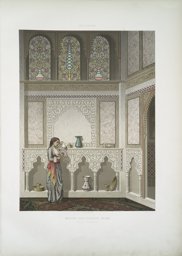
In the oil painting discussed here however, Gérôme did not represent the actual geometric window of the mosque, but depicted rather a stucco and glass window with the motif of a vase with symmetrically disposed stylized flowers. It is a copy of a window in a chromolithograph by the French Orientalist Émile Prisse d’Avennes (1807–1879) that was reproduced in his L’Art arabe d’après les monuments du Kaire, published in four volumes between 1869 and 1877 (IG_31). It shows the upper room of the Cairene house of ‘Sidi Youçouf Adami’. Prisse d’Avenne’s publication became one of the most important reference works for European Orientalist painters in the second half of the 19th century. But, in Gérôme’s case, the transfer may not have happened through the book, but directly through an actor: it was the Dutch painter Willem de Famars Testas (1834–1896) who in 1858 had made the preparatory drawing(s) for Prisse d’Avenne’s lithograph of the ‘Maison Sidi Youçouf Adami’, and de Famars Testas was also well acquainted with Gérôme, as he had accompanied him on his trip to Egypt in 1868 (de Hond, 2013, p. 92, n. 3).
In his oil painting, Gérôme transferred the stucco and glass window of a domestic house in Cairo to a religious building in Istanbul, relocating it to a new geographical and architectural context. Gérôme combined two sources – Prisse d’Avennes’s book illustration, and his own studies made on site – to create his painting and to provide a supposedly authentic image of a religious interior in the Ottoman empire.

Datierung
c. 1880
Zeitraum
1875 – 1900

Bibliografie und Quellen

Literatur

Bakirer, Ö. (1985). Ottoman Glass Manufacture and Venetian Impacts. In H. Filitz & M. Pippal (Eds.), Europa und die Kunst des Islam. 15. bis 18. Jahrhundert. Leitung der Sektion: Oleg Grabar (Akten des XXV. Internationalen Kongresses für Kunstgeschichte V) (pp. 147–157). Böhlau.

Bakirer, Ö. (2001). Window Glass in Ottoman Vernacular Architecture. EJOS (Proceedings of the 11th International Congress of Turkish Art), IV/9, 1–29.

De Hond, J. (2013). "Ceci aura néanmoins probablement son utilité": Willem de Famars Testas au Caire, 1858-1860. In: M. Volait (ed.), Le Caire dessiné et photographié au XIXe siècle (pp. 69–94). Paris: Picard.

Hélène Lafont-Couturier, H. (2000). Gérôme & Goupil: Art and Enterprise. New York: Dahesh Museum of Art.

Prisse d’Avennes, É. (1869–1877). L’art arabe d’après les monuments du Kaire depuis le VIIe siècle jusqu’à la fin du XVIIIe. 4 Vols. J. Savoy & Cie.

Roberts, M. (2010). Gérôme in Istanbul. In S. Allen, & M. Morton (eds.), Reconsidering Gérôme (pp. 119–134). Los Angeles: J. Paul Getty Trust.

Bildinformationen

Name des Bildes
MISC_IG_Gerome_IG_149
Fotonachweise
Artvee
Copyright
Public Domain

Weiteres Bildmaterial und verwandte Objekte

Verwandte Objekte
Cairo, Maison Sidi Youçouf Adami: salon supérieur

Zitiervorschlag

Tabbal, S., & Keller, S. (aktualisiert) (2025). Rüstem Pasha Mosque Istanbul. In Vitrosearch. Aufgerufen am 5. Dezember 2025 von https://www.vitrosearch.ch/objects/2712993.

Informationen zum Datensatz

Referenznummer
IG_149