Forschung
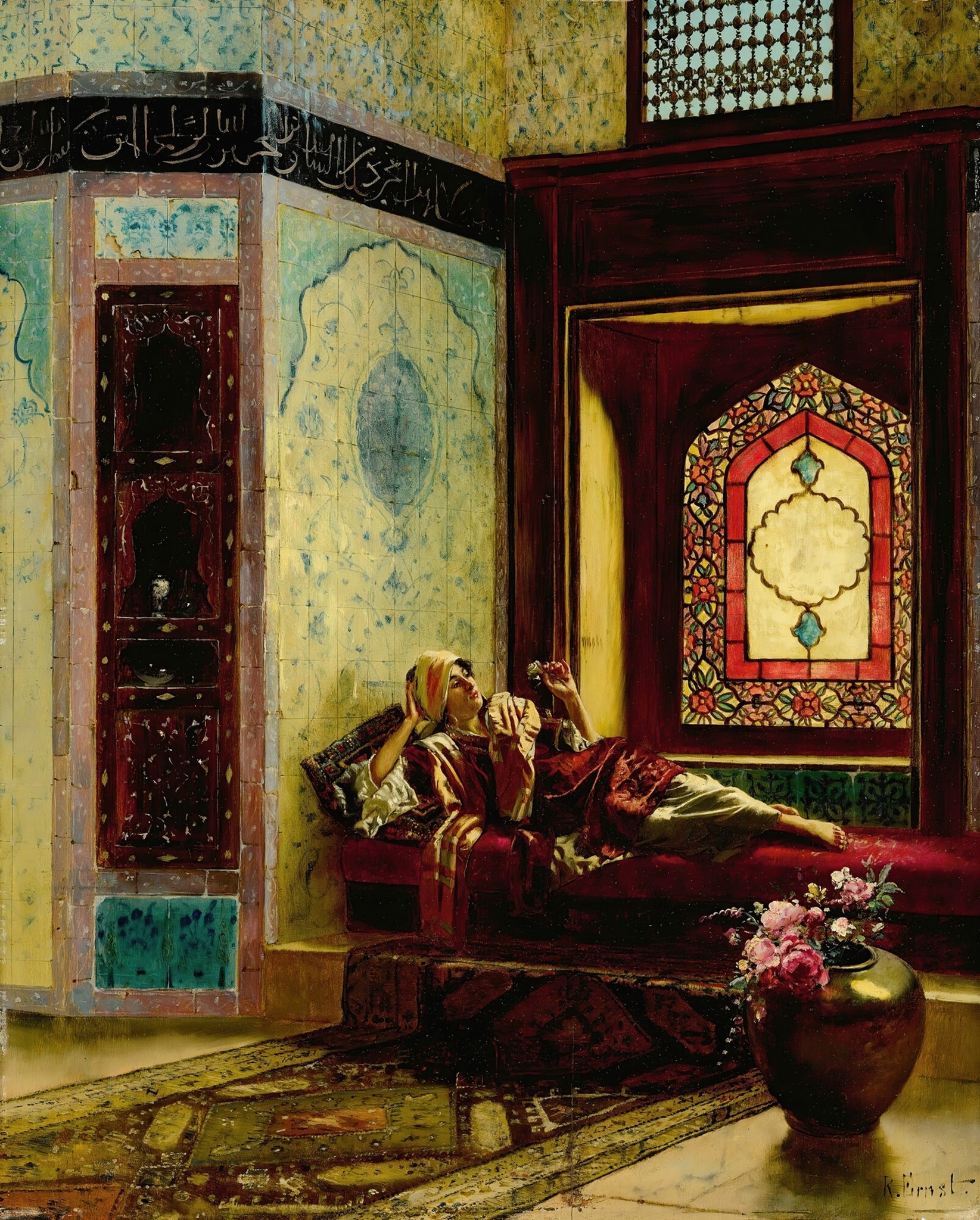
Rudolf Ernst also depicted stucco and glass windows in other Orientalist paintings (see for example IG_137, IG_141, and IG_153). For his painting Languorous Oriental Lady with a Rose, Ernst may have been inspired by contemporary photographs: by comparing the interior in Ernst’s painting with a contemporary photograph by Abdullah Frères (c.1880, Intérieur du Kiosque de Bagdad, which shows furnishings and wall decoration, 20.9 × 26.9 cm, Pitt Rivers Museum, Oxford, 1998.282.2), parallels can be seen in the representation of the interior, such as the divan in the niche, the Iznik tiles decorated with stylized floral elements, and the Arabic inscriptions, as well as the stucco and glass windows. While the photograph taken by Abdullah Frères, which captures the so-called Baghdad Kiosk (located in the fourth court of Topkapı Sarayı), shows three stucco and glass windows in a tall portrait format, Ernst reduced the number of windows in his painting to one and rendered it more square in shape. Not only the form, but also the ornamentation of the window depicted by Ernst does not entirely correspond with the windows in the photograph: the central part with the circle is similarly structured, but the frame with the stylized flowers cannot be seen in the contemporary photograph. Ernst may have painted the flowered frame in order to create a motivic connection between the architecture and the scene shown in the painting: the motif of the flower is taken up by the reclining woman, who holds a flower in her left hand, as well as the flowers arranged in a vase in the foreground.
Datierung
c. 1890
Zeitraum
1870 – 1920