Forschung
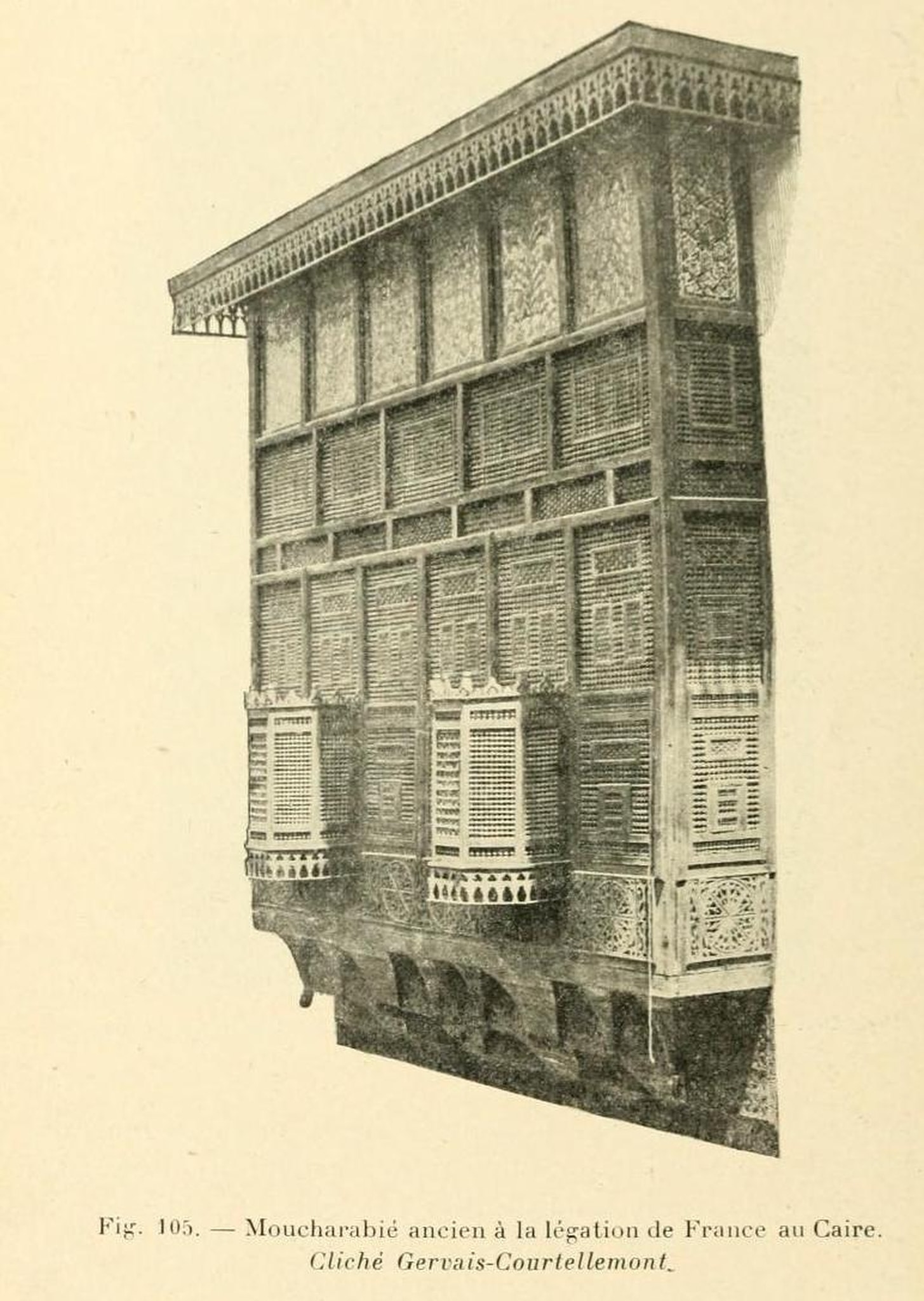
The French architect and specialist in Islamic architecture, Henri Saladin, wrote the section on architecture of the Manuel d’art musulman, published in 1907. He describes the stucco and glass windows of Damascus and Constantinople in brief and praises their ‘charme singulier’ (vol. 1, pp. 68–70, 168). An accompanying photograph, made by the French photographer Jules Gervais-Courtellemont (1863–1931), illustrates the description. It shows the oriel window with mashrabiyya in the mansion of Gaston de Saint-Maurice in Cairo, built in 1875–79, with a row of eight stucco and glass windows in the upper part.
The mansion of Saint-Maurice was built by reassembling older architectural elements for the interiors, among them marble-mosaic floors and walls, ivory-inlaid doors, polychrome wooden ceilings, and the mashrabiyya with its eight stucco and glass windows. In 1884, the French Ministry of Foreign Affairs bought the house for diplomatic use. In 1937, when the French embassy moved to new premises, the house was demolished, but some of its decor was dismantled and reassembled in the new chancellery (Volait, 2012, p. 171; Volait, 2021, chap. 1.2). There is still a niche there with a row of six stucco and glass windows, which seem to be the ones taken from the house of Saint-Maurice.
Some years before Saladin, the journalist and illustrator Charles Lallemand (1826–1904) published the same photograph of the mashrabiyya of Saint-Maurice in his book Le Caire (Lallemand, 1894, p. 19). The image is not cropped as in Saladin’s illustration but shows the façade of the house with the oriel window. Lallemand was the father-in-law of the photographer Gervais-Courtellemont, who had been married to Hélène Lallemand (1860–1922) since 1894 (Devos, 2013, p. 216).
As in the publications of Pascal Coste (IG_69) and Delort de Gléon (IG_269), in Saladin’s illustration the stucco and glass windows are shown from the outside in their original setting.
Datierung
1907
Verknüpfte Standorte