Matériaux
Gypsum plaster, colourless glass with yellowish and greenish tint; coloured glass (green, turquoise green, blue, two shades of yellow), red flashed glass
Technique
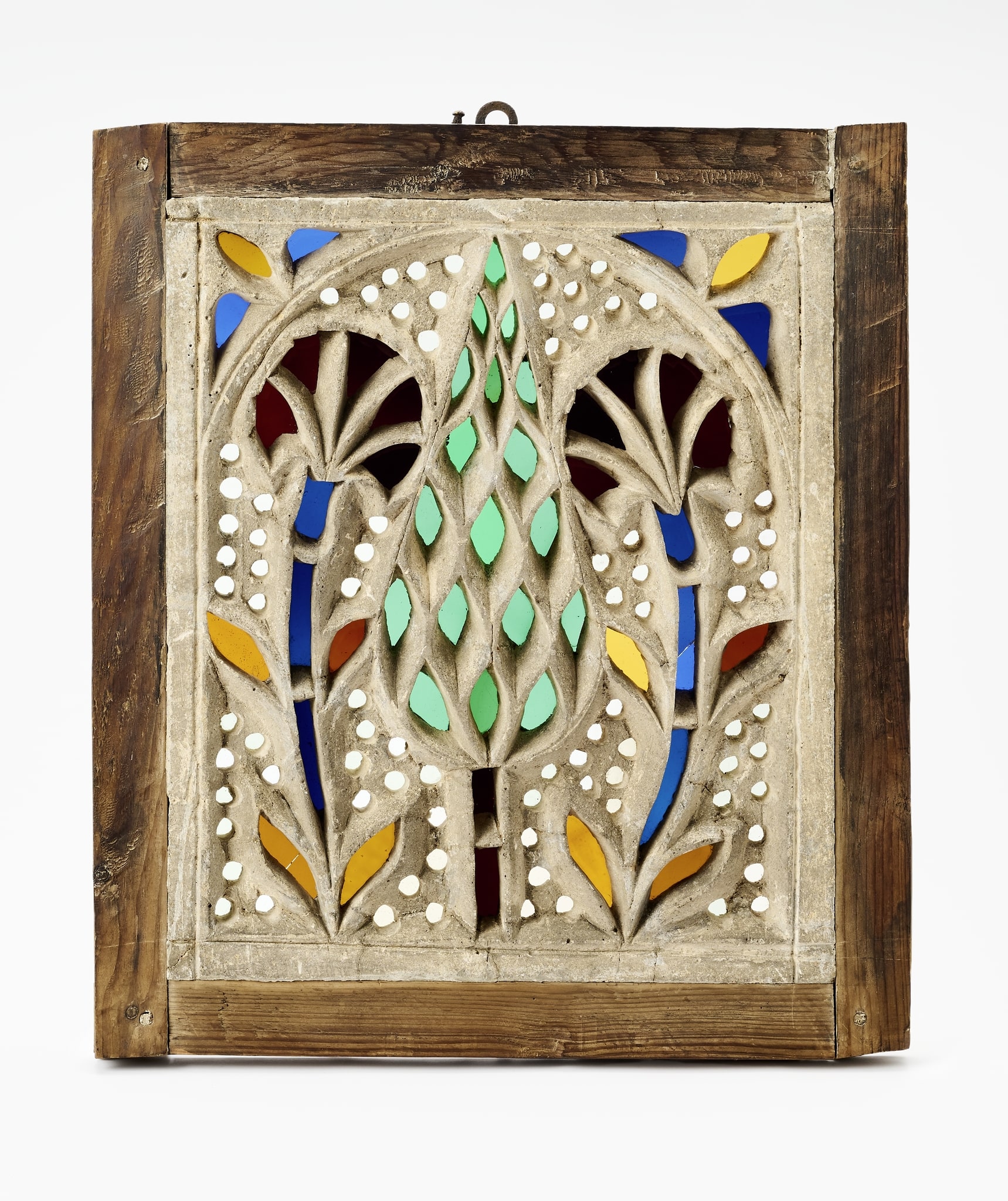
Latticework carved into a rectangular stucco panel and inlaid with pieces of colourless and coloured sheet glass.
To create the stucco panel, gypsum plaster was poured into a wooden frame. The openings in the lattice were cut out of the stucco panel, when it was not yet completely set, using sharp tools. Once the latticework was finished, the coloured glass pieces, cut to the size of the openings using a glass cutter, were embedded in a thin layer of gypsum plaster and fixed to the back. This layer is on average 2.3–2.5mm thick. The thickness of the stucco panel is c.22–25mm.
The design of the latticework is laid out on two levels: the main design (level 0) was carved out of the stucco panel using sharp, knife-like tools and following the lines of a preliminary drawing incised in the surface of the panel. Traces of the incisions are still visible in some places on the front. The second level (level –1), which lies c.10–14mm below level 0, shows irregularly spaced, conical perforations with diameters of c.10–14mm. The holes were pierced with a metal or wooden pin in the stucco before it was fully set. The main design and the perforations have been worked in such a way that the incident light is directed slightly downwards into the room.
The holes are backed with colourless glass. Green, turquoise, blue, purple, yellow, and red flashed glass was used in the floral and geometric motifs. Small, elongated bubbles as well as uneven surfaces indicate that the glass sheets are mouth-blown. The bubbles run in parallel, suggesting the use of the broad-sheet or cylinder-blowing method. The glass pieces have a thickness of c.1.5mm.
Etat de conservation et restaurations
This stucco and glass window is preserved in its original wooden frame. Probably around 50% of the glass is original.
The window was restored as part of a master’s thesis project (Rautenberg, 2003). During the restoration, the object was carefully cleaned, minor defects in the stucco lattice were repaired, and missing pieces of glass were replaced (Rautenberg, 2003, pp. 66–74). In accordance with current conservation standards, the additions are distinguishable from the original materials.
There is evidence of an earlier restoration involving the replacement of glass pieces and the use of shellac as an adhesive to consolidate fissures in the stucco lattice (see Rautenberg, 2003, pp. 14, 21–24).