
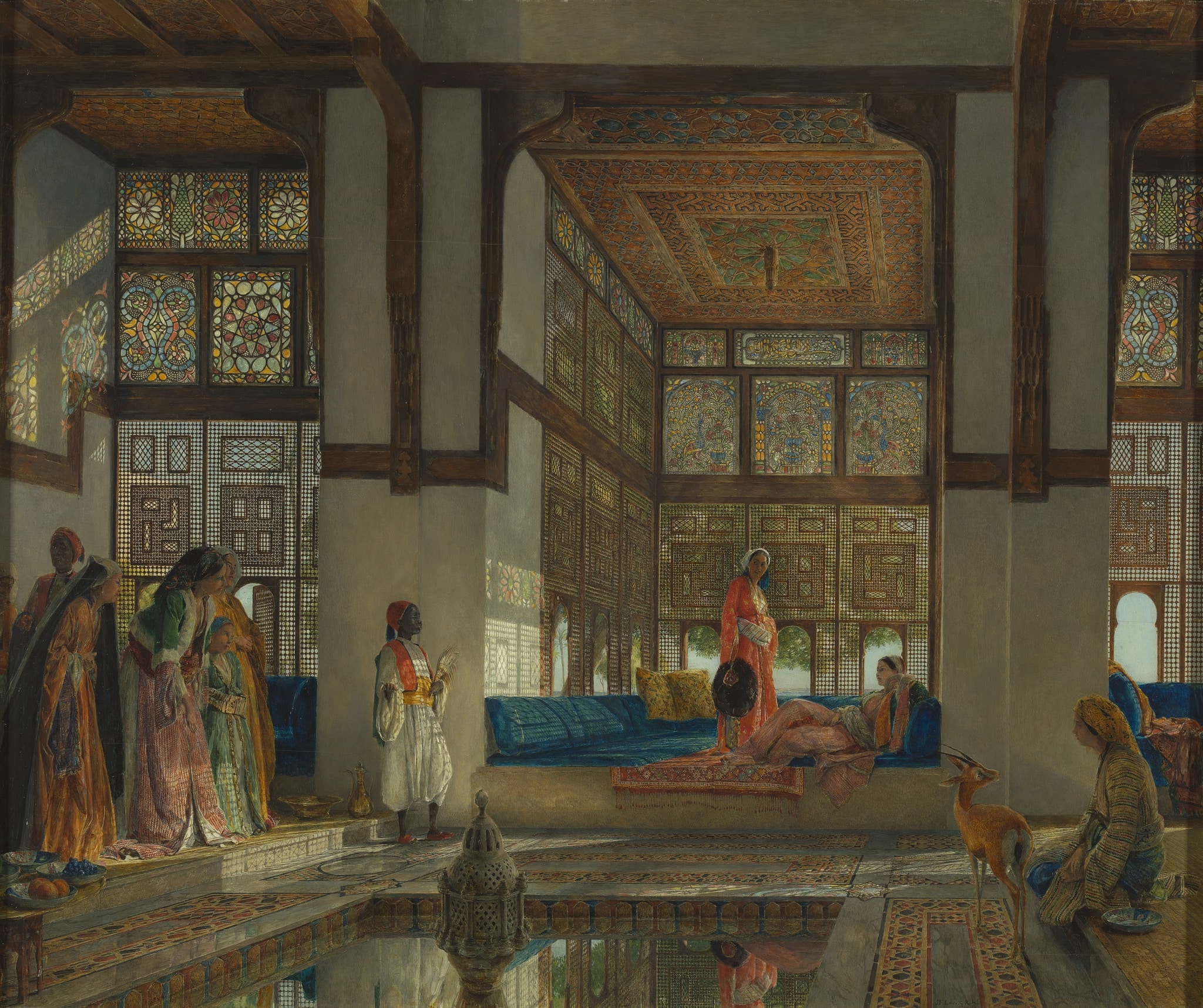
The Victorian painter John Frederick Lewis (1804–1876) depicted stucco and glass windows in his oil painting A Lady Receiving Visitors(The Reception), which was completed in 1873 and visualizes the mandarah (room where guests are received) of a domestic interior with several women, children, and a gazelle.
Lewis recorded the architectural elements of the Egyptian interior in detail, with a square water-filled basin surrounded by three bays. The luminous space is lent character by the wooden lattices in the lower half of the bays and the coloured stucco and glass windows above. Bright daylight floods the interior, streaming in through the lattices and the multi-coloured stucco and glass windows, partially reflected on the different surfaces of the interior, and creating a play of light, shadow, and colour (Weeks, 2014, pp. 111–127). The window in the central bay with the motif of a vase of flowers is flanked by two windows that mirror each other with the motif of a stylized peacock standing next to a smaller vase of flowers. Above these three figurative windows is another narrow upper row of rectangular windows: the one in the centre bears a cartouche with a Quranic inscription in yellow, and the two on either side show motifs of vases of flowers and palm trees. The coloured stucco and glass windows in the recesses to the left and right of the central bay mirror one another and show various geometric motifs (in the lower row), and again stylized cypresses and geometric ornament (in the upper row). The complementary colours of blue and orange, as well as the red and green of the windows, are echoed in the painted wood, the marble intarsia, the textiles, and the garments of the women (Weeks, 2014, p. 110).
25G3(CYPRESS) · arbres : cyprès
41A2 · intérieur de maison
41A33 · fenêtre
41A6711 · fleurs dans un vase
48C1412 · l'intérieur ~ représentation d'un édifice