Research
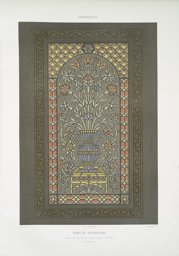
This lithograph, preserved in émile Prisse d’Avennes’s album Art Arabe. Dessins: Arabesques, 5 held at the Bibliothèque Nationale de France in Paris, was a coloured proof for the French archaeologist’s book L’Art arabe d’après les monuments du Kaire depuis le VIIe siècle jusqu’à la fin du XVIIIe, published in 1877 (vol. 3, pl. CXLV, IG_43).
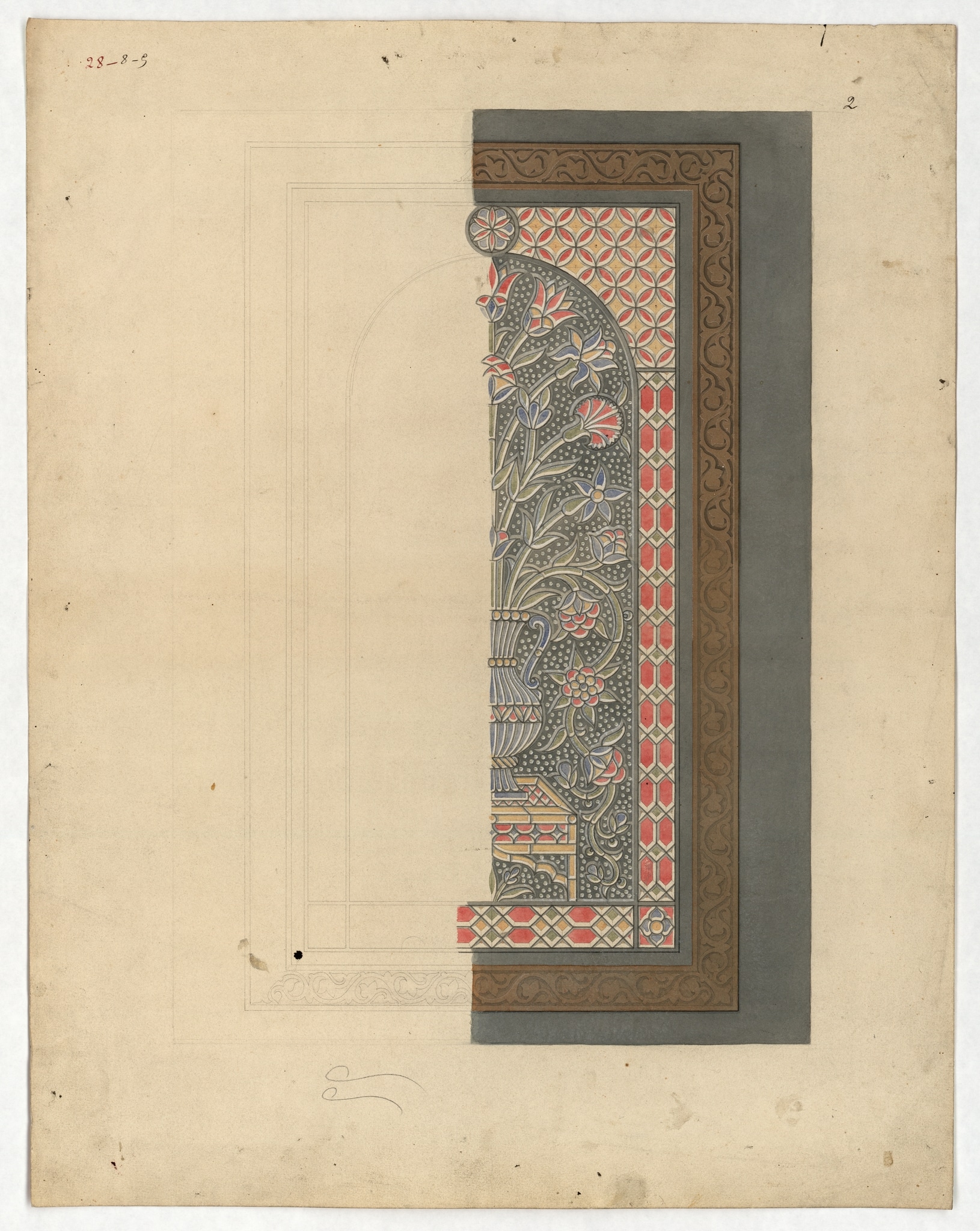
The window depicted was reconstructed from fragments. Prisse d’Avennes explains that he had been able to buy in Paris three boxes with fragments of six stucco and glass windows from a mosque in Egypt. In 1867, these windows had been sent from Egypt to the world’s fair in Paris, but had not survived the journey and therefore arrived there in pieces. Prisse d’Avennes succeeded in reconstructing two windows (Prisse d’Avennes, 1869–1877, vol. 1, pp. 154, 278, vol. 3, pl. CXLV; Keller, 2020, p. 31).
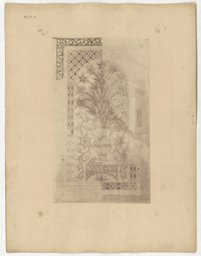
A photograph of these fragments can be found in one of Prisse d’Avennes’ Cairo’s portfolios (IG_86). Furthermore, a reconstruction drawing is preserved, which shows the floral and geometrical motifs of the fragments in different compositions (Bibliothèque nationale de France, Fonds Prisse d’Avennes, IG_488).
Prisse d’Avennes reports that the seller of the fragments, M. Maynard, had the windows removed from a mosque called ‘Gama-el-Achrafieh’ in Cairo. The Egyptologist identified this building with the Mosque of Al-Ashraf Barsbay, begun in 828 AH / 1425 CE, but admitted himself that there were other al-Ashraf mosques in Cairo (e.g., of Sultans Inal and Qaytbay).
Dating
c. 1870
Period
1860 – 1877
Related Locations
Place of Manufacture