
Image Ordered

IG_447: Record Drawing of Stained Glass
(GBR_London_VAM_IG_447)

Contact Details

Please specify your first name.
Please specify your name.
Please specify your e-mail address.
The e-mail address is invalid.

Please provide as much information as possible (publication title, database, publisher, edition, year of publication, etc.).

The Vitrocentre Romont can only provide you with its own photographs. We regret that we cannot supply images from third parties to you. If your order concerns photographs from third parties, we will send you the contact address from which the images can be obtained.

The personal data you provide in this form will be used by Vitrocentre Romont exclusively for the processing of your image order. Correspondence regarding the order will be archived for internal reference. The data will not be used for purposes other than those listed here, nor will it be passed on to third parties. By sending the order form, you agree to this use of your personal data.

Should you have any questions, please send us an e-mail: info@vitrosearch.ch.

Title

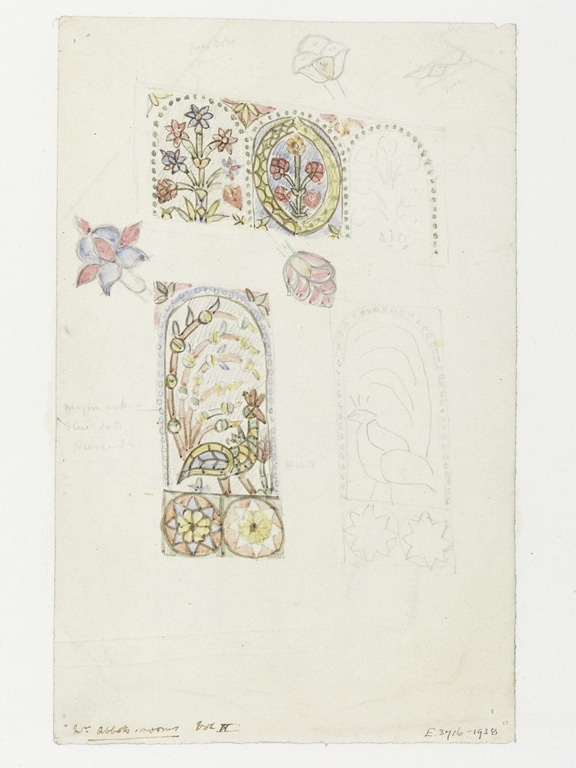
Stucco and glass windows in the house of Dr. Abbott

Type of Object
Dimensions
21 x 13.5 cm
Artist / Producer
Dating
c. 1845
Location
Inventory Number
E.3716-1938
Research Project
Author and Date of Entry
Sarah Tabbal 2024

Iconography

Description

This pencil and watercolour drawing by the British architect James William Wild (1814–1892) shows five rectangular stucco and glass windows in two rows. Only three of the windows were executed completely in colour: the others are only indicated in fine pencil lines.
In the lower row, a rectangular window can be seen, consisting of a rectangle with two squares below. The rectangle shows the motif of a stylized peacock within an arch, and each of the two squares a star and stylized blossom within a circle. On the right-hand side, Wild has drawn a window with the same motif, but not coloured it. The two peacocks face each other in mirror image.
In the upper row, there are three windows with the motif of stylized flowers. The arrangement appears to be symmetrical around the vertical axis of the central window, which represents flowers within an oval form. This is flanked by a window on the left, which shows flowers within an arch, and one on the right indicated in a pencil drawing with colour only for the perforation in the arch (green) and the left-hand corner (yellow and red). The pencil outline and the symmetrical arrangement indicate that the right-hand window bore the same motif as that on the left.
The space around the windows has been used for enlarged details, in this case flowers from the upper left window.
A flower above the top row of windows bears letters indicating the colour of the petals: the ‘y’ in the centre represents an abbreviation for ‘yellow’, and the ‘r’ in three other fields is probably for ‘red’. Blossoms similar in shape and colour can be seen in the central window of the upper row. To the left of the enlarged flower is another inscription that reads ‘green dots’. The green glass backing the perforations of the spandrels to the arches in the upper row of windows was painted by Wild as a large number of small green dots. Wild also added further pencil notes in the drawing. The inscription between the two windows with the peacock motif is not legible.

Iconclass Code
25F35(PEACOCK) · ornamental birds: peacock
25G41 · flowers
Iconclass Keywords
Inscription

green dots / green (in the upper left-side of the drawing)
[…] arch blue dots pierced (in the central left-hand corner of the drawing)
Mr. Abbots rooms Vol. II (in the lower left-hand corner of the drawing)

Materials, Technique and State of Preservation

Technique

Pencil and watercolour on paper.

History

Research

The inscription naming ‘Mr. Abbots’ refers to Dr Henry William Charles Abbott (1812–1859), who was a British physician and collector of Egyptian antiquities. He ‘went to Egypt when quite a young man, on a scientific expedition, under the auspices of the British government’ and was ‘for narly thirty years the only resident English physician in Cairo’ (Littell, 1859, p. 592). He lived in a ‘house in Cairo, filled with his splendid collection’: ‘He began the practice of collecting antiquities as an amusement, and it at length became a passion, so that he devoted his entire surplus income to the museum which he gathered around him, and which became at length one of the finest in the world.’ (Littell, 1859, p. 592). Today, some of the objects of the Abbott Collection are held in the Brooklyn Museum in New York; stucco and glass windows are not among them however. Wild treated windows associated with the name Abbott in several other drawings (IG_438, IG_439, IG_444, IG_445).

Dating
c. 1845
Period
1844 – 1847
Related Locations
Place of Manufacture

Provenance

Owner
Victoria and Albert Museum, Inventory Number: E.3716-1938
Previous Owner

Elizabeth H.M. Wild

Bibliography and Sources

Literature

Littell, E. (1859). Littell’s Living Age. Boston: Littell, Son, and Company.

Image Information

Name of Image
GBR_London_VAM_IG_447
Credits
© Victoria and Albert Museum, London
Link to the original photo

Citation suggestion

Tabbal, S. (2024). Stucco and glass windows in the house of Dr. Abbott. In Vitrosearch. Retrieved December 5, 2025 from https://www.vitrosearch.ch/objects/2713291.

Record Information

Reference Number
IG_447