Research
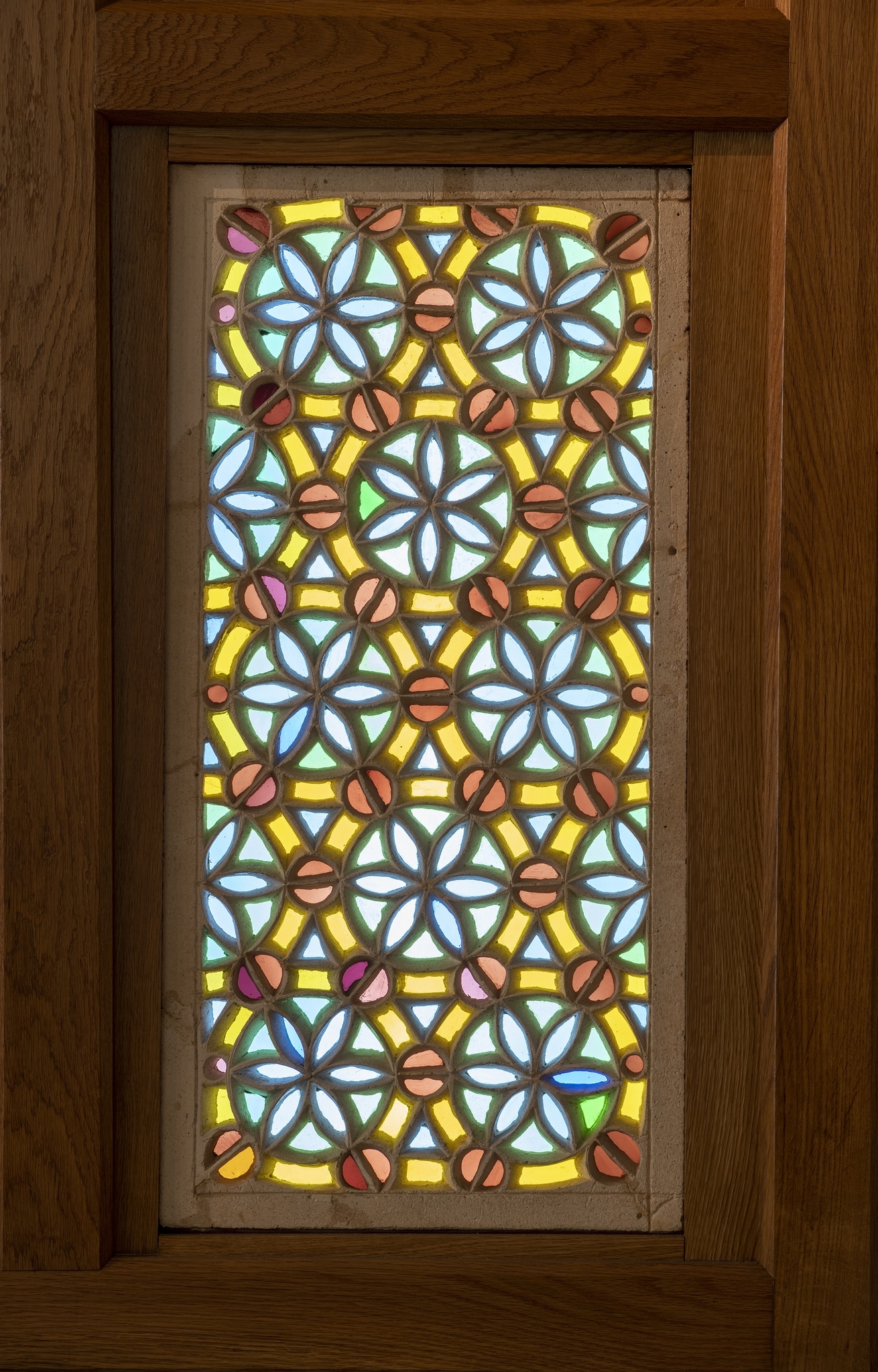
This stucco and glass window shows the characteristics of Islamic ornamentation. The regular layout of repeating elements creates a repetitive surface decoration. The geometric arrangement of the basic elements is strictly maintained. The British architect James William Wild (1814–1892) documented a similar window with a comparable, but slightly simpler design during his stay in Cairo in the years 1844–1847 (IG_439). There are no other examples of such ornamental windows in the collections studied within this project.
From a technical point of view, it can be assumed that the window discussed here was made in an Egyptian workshop. Although the rear of the window was not accessible during our examination, it can be concluded from the restoration report of 2004 that the window was made according to the traditional technique used in the manufacture of qamariyyāt in North Africa to this day (see Technique).
According to the museum records, the window dates to the 16th or 17th century. However, there are some indications that speak against this early date. On the one hand, the abstract design of the spandrels suggests a later dating. On the other hand, the window was in a relatively good state of preservation before restoration in 2003, despite the poor weather resistance of the stucco lattice. If the window had been installed in a building in the 16th or 17th century and been exposed to the weather for two or three centuries, we would have expected it to be more heavily weathered before restoration. Moreover, the pieces of glass show the characteristics of cylinder-blown sheet glass, a technique that was uncommon in the Islamic world at that time and more commonly used in Europe. Interestingly, the Hungarian architect Max Herz (1856–1819) states in 1902 that sheet glass was imported to Egypt from Europe from the 19th century, because local sheet-glass production had come to a standstill (Herz, 1902, p. 53).
The Cairo-based, Cypriot art and antique dealer Phokion Tanos (1898–1972) donated this window – along with 12 other qamariyyāt (11049–11059, 20969, 20960, see IG_336–359), to the Benaki Museum in Athens, probably in the 1940s.
Dating
early 13th–early 14th centuries AH / 19th century CE
Period
1800 – 1899
Previous Locations
Place of Manufacture