Image Ordered

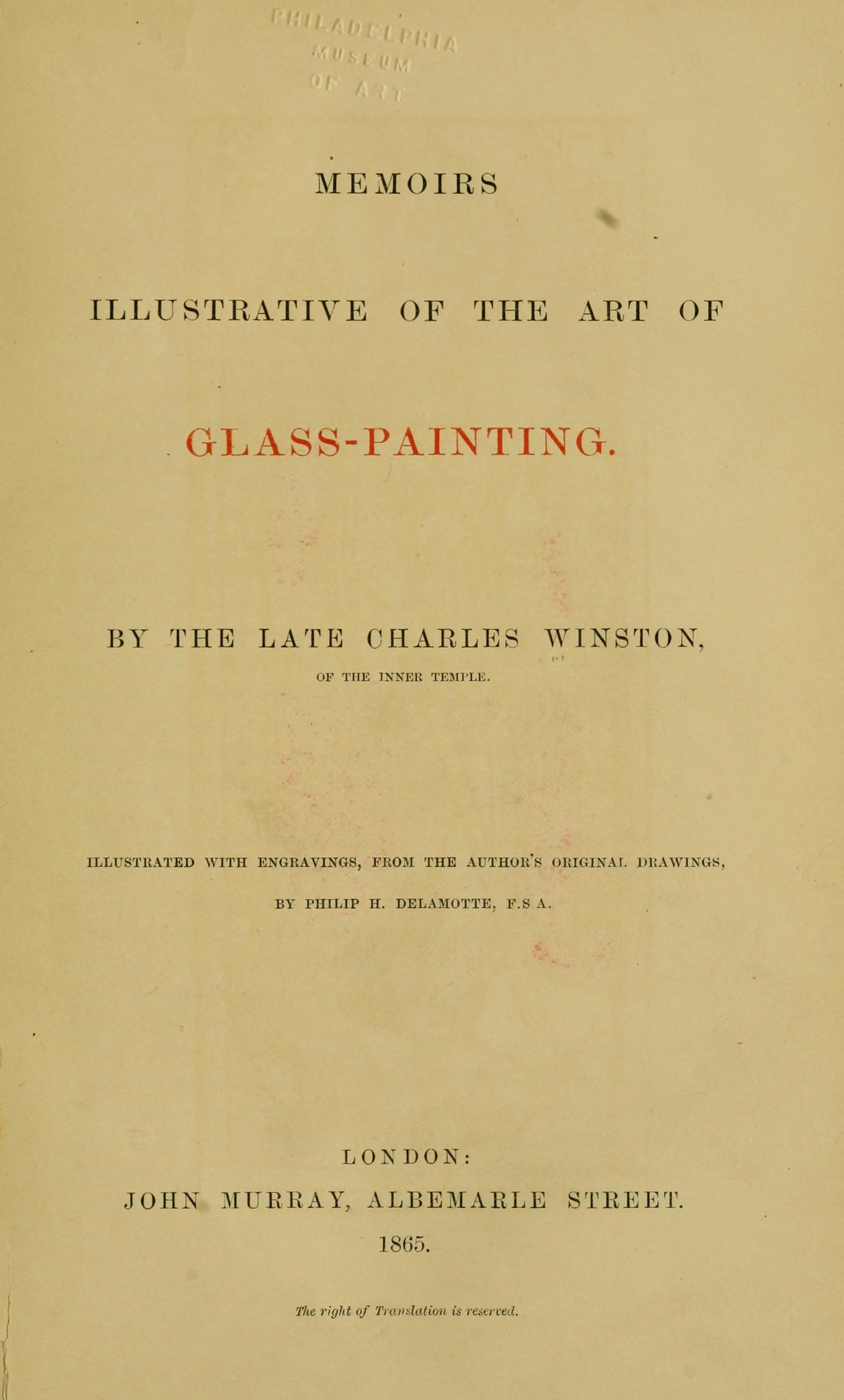
IG_329: Charles Winston, A Lecture on Glass-painting, 1865
(MISC_IG_Winston_1865_IG_329)

Contact Details

Please specify your first name.
Please specify your name.
Please specify your e-mail address.
The e-mail address is invalid.

Please provide as much information as possible (publication title, database, publisher, edition, year of publication, etc.).

The Vitrocentre Romont can only provide you with its own photographs. We regret that we cannot supply images from third parties to you. If your order concerns photographs from third parties, we will send you the contact address from which the images can be obtained.

The personal data you provide in this form will be used by Vitrocentre Romont exclusively for the processing of your image order. Correspondence regarding the order will be archived for internal reference. The data will not be used for purposes other than those listed here, nor will it be passed on to third parties. By sending the order form, you agree to this use of your personal data.

Should you have any questions, please send us an e-mail: info@vitrosearch.ch.

Title

A Lecture on Glass-painting

Type of Object
Artist / Producer
Winston, Charles · Author
Dating
1865
Research Project
Author and Date of Entry
Sarah Keller 2025

Iconography

Description

Charles Winston’s lecture on glass-painting was delivered before the Working Man’s Association at Lichfield in 1859 and later published in Charles Winston, Memoirs Illustrative of the Art of Glass-Painting, London: John Murray 1865, pp. 231–255.

History

Research

The British stained glass historian Charles Winston (1814–1864) introduced the subject of Islamic stucco and glass windows to a British audience interested in stained glass.

He first refers to the Byzantine church of Hagia Sophia in Constantinople and its coloured glazing, described by an ‘ancient writer’ (probably Silentiarius Paulus) and documented in the recent examination ‘by the architect employed by the Prussian government’ (Wilhelm Salzenberg; see Salzenberg, 1854). He also believed that painted glass originated in Constantinople, the ‘cradle of the arts’. However, owing to wartime destruction, nothing has survived except the more recent windows of the mosques. Winston observes that their manufacturing technique goes back to that of the Byzantine windows of the Hagia Sophia and is only slightly modified. He explains that his friend, the architect William Burges, who also had written about Constantinople’s windows (IG_189), had shown him a drawing of one of the windows of the Süleymaniye Mosque, dating to the 10th century AH / 16th CE (IG_91). He compares it with a window brought some years before from Cairo to London by James Spencer Bell (1818–1872), a former MP for Guildford. In 1869, this window entered the collection of the South Kensington Museum (see Thomas, p. 17), but it has not been further identified. Winston subsequently described the technique of the window and the oblique carving, emphasizing the thinness of the glass (Winston, 1865, pp. 236, 237).

Dating
1865
Period
1859 – 1865
Place of Manufacture

Bibliography and Sources

Literature

Salzenberg, W. (1854). Alt-christliche Baudenkmale von Constantinopel vom V. bis XII. Jahrhundert: Im Anhange des Silentiarius Paulus Beschreibung der Heiligen Sophia und des Ambon. Berlin.

Thomas, A. (2013). James Wild, Cairo and the South Kensington Museum. In: Volait, M. (Ed.), Le Caire dessiné et photographié au XIXe siècle. Paris: Publications de l’Institut national d’histoire de l’art. doi:10.4000/books.inha.4871.

Winston, C. (1865). A Lecture on Glass-painting. In Memoirs Illustrative of the Art of Glass-Painting (pp. 231–255). London: John Murray.

Image Information

Name of Image
MISC_IG_Winston_1865_IG_329

Citation suggestion

Keller, S. (2025). A Lecture on Glass-painting. In Vitrosearch. Retrieved December 5, 2025 from https://www.vitrosearch.ch/objects/2713173.

Record Information

Reference Number
IG_329