
Description
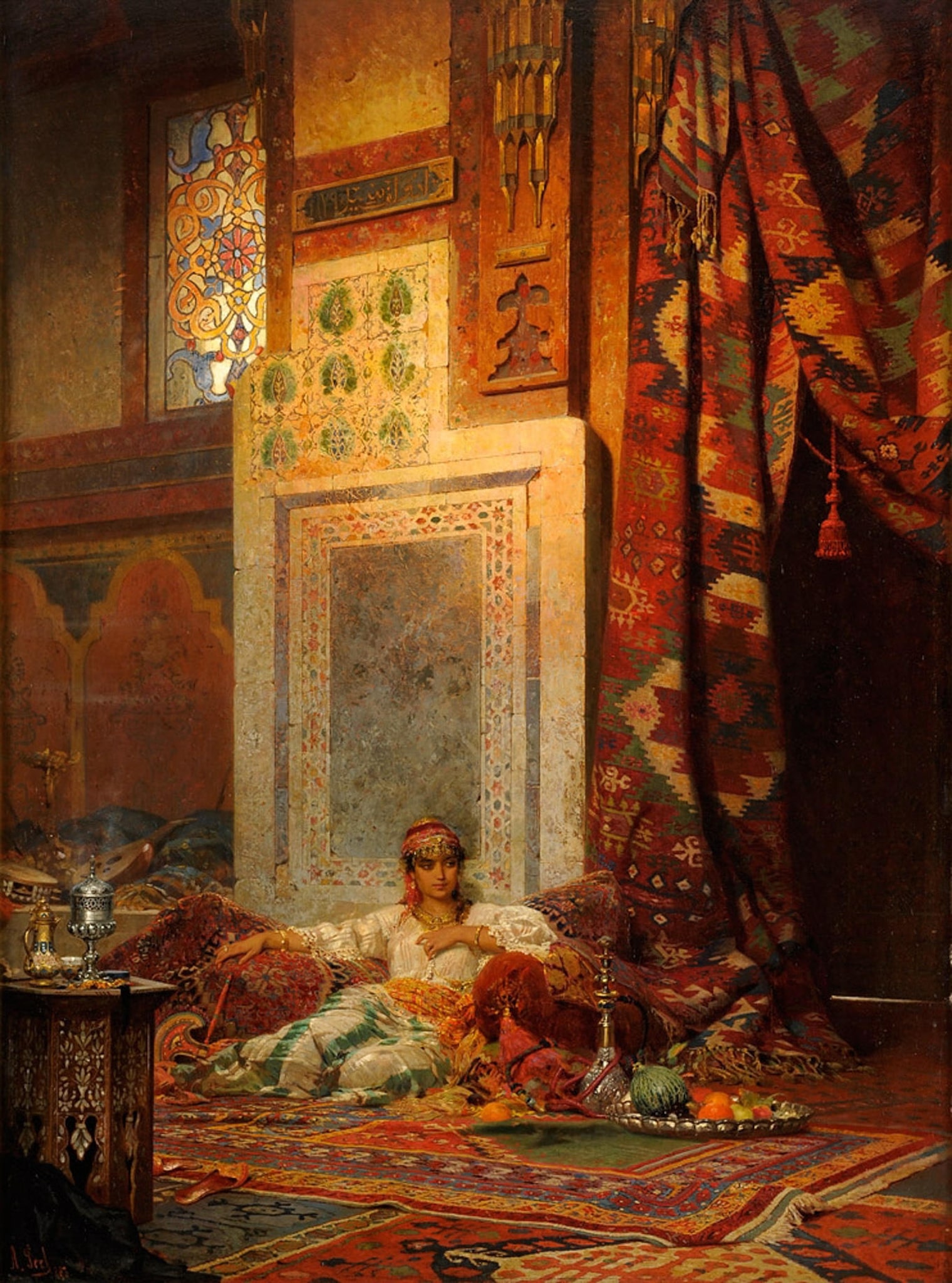
The oil painting Die Favoritin by the German Orientalist artist Adolf Seel (1829–1907) shows a ‘harem’ scene with a woman sitting on the floor of a richly decorated interior, with carpets spread out on the floor and a hanging on the wall. A coloured stucco and glass window is depicted in the upper left-hand section of the painting. The window shows a symmetrically arranged geometrical motif with a stylized red blossom in the centre. The glass in the window is predominantly white, yellow, orange, red, and blue.
Iconclass Code
41A2 · interior of the house
41A33 · window
42Z11 · harem
48A981 · ornament ~ geometric motifs
48C1412 · interior ~ representation of a building
41A33 · window
42Z11 · harem
48A981 · ornament ~ geometric motifs
48C1412 · interior ~ representation of a building
Iconclass Keywords
abstract art ·
feigned window ·
geometry ·
harem ·
house ·
interior ·
optical illusion ·
sham-window ·
window